
49. In Korea, a Mother Is Not Expected to Bounce Back
Why postpartum recovery is treated as a sacred, social, and bodily reality rather than a private afterthought

If your hands are busy (perhaps rocking a cradle or stirring some seaweed soup), you can listen to the expanded companion audio of this story right here.
When I was pregnant and living in the U.S., the conversations I had seemed to follow two distinct cultural tracks.
My non-Korean friends usually asked whether I was having a girl or a boy, whether my morning sickness was manageable, and whether I was staying healthy. They also asked what my maternity leave would look like, what my childcare plans were, and whether we had picked a name.
My Korean friends asked those things too. But what they really wanted to know was something else.
So what are you going to do for sanhujori (산후조리)?
They wanted to know how I was going to recover.
Friends in Korea were particularly concerned.
They had heard the stories — and in Korea, stories about giving birth in America circulate with the energy of urban legend. No postpartum care centers. Mediocre hospital food. Mothers discharged almost immediately after delivery. Photos of what Korean women in American hospitals were served — pizza and Sprite — had been shared and reshared online, greeted with the Korean internet’s version of horrified disbelief.
“Can you imagine? In America, they do this.” The memes wrote themselves.
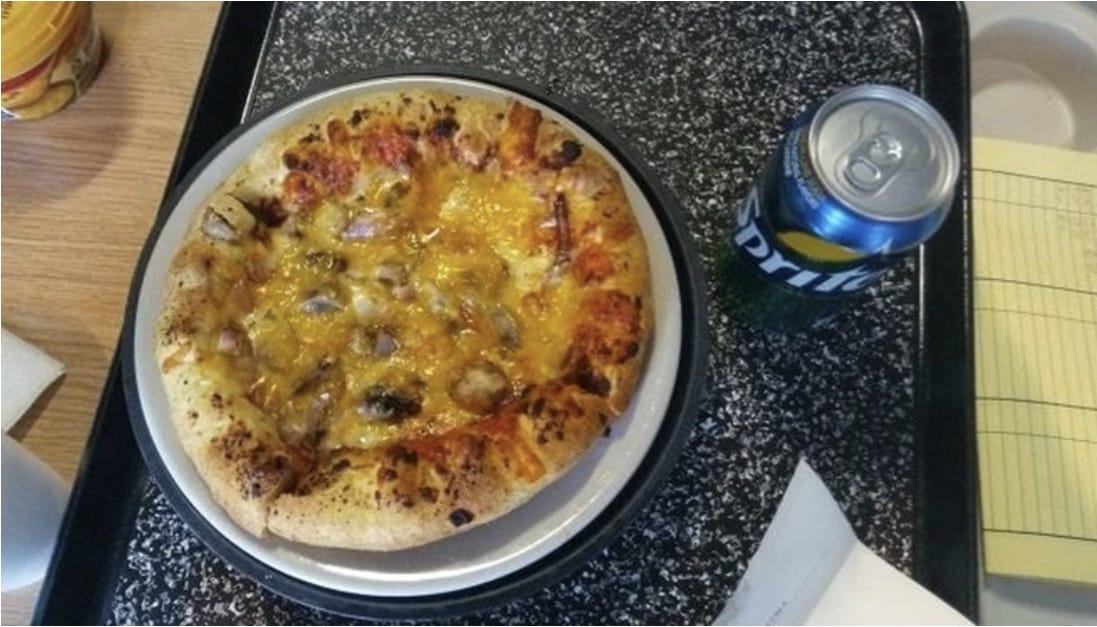
My Korean friends wanted to know: Was my mother flying over from Korea? Did I have a plan?
It was one of those moments when you suddenly realize that two cultures are not simply doing the same thing with different accents. They are telling different stories about what birth is.
In one story, birth is the moment of becoming a mother. The main event, the finish line, the beginning of a new chapter focused on the child.
In the other, it is also the beginning of a mother’s recovery.
That second story is the Korean one.
The Question Behind the Question
The Korean word sanhujori (산후조리) is usually translated as “postpartum care,” which is accurate but incomplete. Literally, it means something closer to regulating or restoring the body after birth. It is not just rest. It is repair.
And that repair is taken very seriously.
Koreans often say, with the kind of certainty usually reserved for tax deadlines and family gossip, that if you do not do your sanhujori properly, you may suffer for the rest of your life.
The details vary, but the logic is consistent: childbirth leaves the body depleted, open, vulnerable, and in need of careful restoration. In Korean medicine and in popular wisdom alike, birth is not treated as a cute milestone with pastel balloons. It is treated as a major physical event.
That is why even the everyday language around postpartum recovery in Korean can sound strange when translated directly into English.
People say a woman needs to “loosen her body” after birth, or momeul pulda (몸을 풀다) — literally “to release” or “untangle” the body. The phrase sounds odd in English, almost like someone is describing a knot in a shoelace. But the image is revealing. A body that has endured pregnancy and labor is imagined as strained, swollen, tightened, and thrown out of alignment. Recovery is the slow work of settling it back into itself.
Not bouncing back.
Not “getting your body back.”
More like persuading your body that the emergency is over.
Twenty-One Days, and the Wisdom of a Closed Door
One of the oldest ideas in Korean postpartum culture is samchilil (삼칠일), literally “three sevens,” or twenty-one days.
Traditionally, the first twenty-one days after a baby’s birth were treated as a protected period. Families often hung a geumjul (금줄), a sacred rope, at the entrance to mark the household as set apart. People who had been to funerals or other ritually “impure” places were not supposed to enter. In folk language, this was about keeping away bad fortune and ritual impurity. In modern language, it also looks uncannily like an early form of quarantine. The mother and newborn were understood to be vulnerable, and the world was asked, for a while, to stay back.
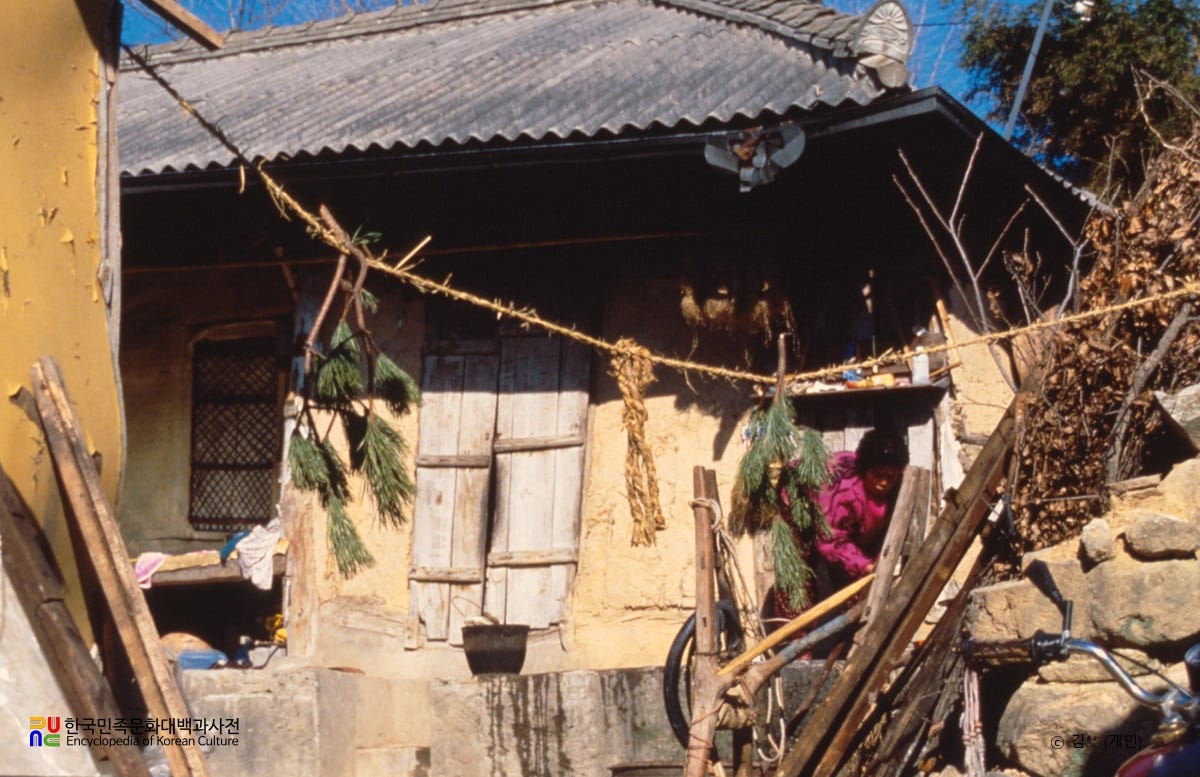
This is the point at which many non-Korean readers pause and think:
Wait. Is this deeply superstitious or surprisingly sensible?
The answer, of course, is that old cultures are often both more symbolic and more practical than modern people like to admit.
Korea did not invent postpartum vulnerability. It ritualized it.
And the number twenty-one was not random. In folk practice, the seventh day, fourteenth day, and twenty-first day each carried meaning, with the final threshold marking the loosening of restrictions and the reopening of ordinary life. In other words, the first three weeks after birth were not treated as a vague haze of exhaustion. They were given shape. They had a timeline. They had rules. They had meaning.
Samshin Halmoni and the First Bowl of Soup
The spiritual life of traditional Korean birth centered on Samshin Halmoni (삼신할머니), a household deity associated with conception, childbirth, and the protection of infants. She was not imagined as remote or abstract, but as a presence watching over the vulnerable threshold between birth and survival.
If you’ve watched the K-drama Guardian: The Lonely and Great God (쓸쓸하고 찬란하神 – 도깨비), you might remember her there too. In the drama, Samshin Halmoni appears in different forms — sometimes old, sometimes young — as a supernatural figure associated with birth, fate, and care. That part is not a screenwriter’s invention: in Korean folk belief, Samshin Halmoni has long been associated with pregnancy, childbirth, and the protection of babies.
This scene is from Guardian: The Lonely and Great God (쓸쓸하고 찬란하神 – 도깨비). Samshin Halmoni holds Eun-tak and tells her she went through a lot, and that she felt happy when she chose her to be born. In older Korean folk belief, babies were often understood as being entrusted or granted by Samshin Halmoni. It is one of the most tender moments in the drama, and it beautifully captures how deeply birth in Korea was once understood not only as biological, but also sacred.
Immediately after a child was born, the household would prepare a samshin sang (삼신상), an offering table with rice, seaweed soup, and clean water. Depending on the household or region, the offerings could be arranged in one set or in three bowls each. This was set in the warmest corner of the main room with prayers for the mother’s recovery and the child’s long life.
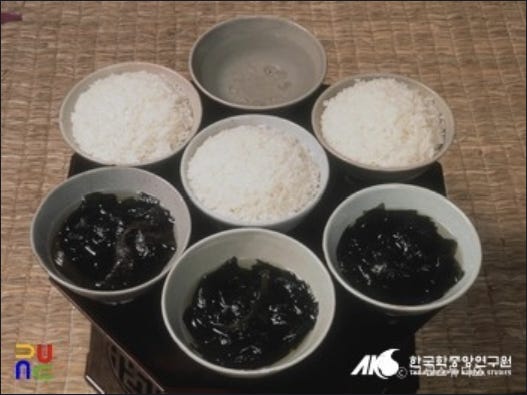
Then the mother ate from it.
The food offered to the goddess became the mother’s first meal after delivery — a dish called cheotkukbap (첫국밥), literally “first soup and rice.” This was not ordinary nourishment. It was the household’s way of saying: you have done something sacred, and we are feeding you with sacred food.
Why Everything Must Stay Warm
Now we arrive at the detail that puzzles most non-Korean observers. Why, in the middle of a Korean summer, is a new mother in long sleeves, wearing thick socks, eating steaming hot soup, in a room where the air conditioning is regarded as a suspicious character with bad intentions?
If you’ve been following this newsletter for a while, you already know that Koreans have a complicated, deeply committed relationship with warmth. It shows up everywhere — in the heated floors, in the soup that arrives at every meal, in the grandmother who hands you a hot drink in July.
Sanhujori (Postpartum care) is where that instinct is most intense. And there’s a reason for it.
Part of the answer involves gi (기, vital energy) and blood. In Korean medicine, childbirth is understood to drain these to their limits. In this depleted state, the body is “open” — the joints loosened, the pores expanded, the internal organs vulnerable.
If cold air, cold water, or cold food enters a body in this condition, it lodges there. It settles into the bones and joints. It causes pain, numbness, chills, and exhaustion that can persist for years.
This is sanhupung (산후풍, literally “postpartum wind”) — the cold that got in because the body wasn’t protected.
The images this produces can be striking to outside eyes. A woman in midsummer, in socks, on a heated floor, drinking hot soup. The air conditioner treated like a threat. This is also exactly why stories about American hospital practices — handing new mothers ice water to drink, encouraging cold showers immediately after delivery — circulate in Korea like a horror film. “They do WHAT?”
In modern biomedicine, sanhupung does not map neatly onto a single diagnosis. Blood tests and imaging may show nothing abnormal, even when symptoms such as joint pain, chronic cold sensitivity, and fatigue are very real. That is one reason the concept can be difficult to translate cleanly into standard biomedical categories.
But there is a more interesting way to read sanhupung, and it comes not from dismissing it but from listening carefully to what it has been encoding all along.
Sanhupung is what medical anthropologists call a culture-bound syndrome — not a disorder that exists only in the imagination, but a way that a particular culture names and gives shape to real suffering. And when you look at the history of Korean women — when you think about the ones who went back to the fields two days after giving birth because the harvest could not wait, the ones who served meals to in-laws while their bodies were still bleeding, the women during wartime and the IMF financial crisis who simply could not afford to rest — sanhupung starts to sound less like superstition and more like a record. The cold got in because the body was never allowed to close.
A society reveals itself by what it treats as urgent. Korea, for all its speed and competitiveness, has long looked at a woman who has just given birth and said: put her somewhere warm. That is not a bad instinct.
(It is also worth noting that Korean traditional medicine is now codifying sanhupung into standardized clinical guidelines, repositioning it as a treatable syndrome with defined interventions. The cultural memory is becoming medical protocol.)
A perfect little scene from the Korean drama Birthcare Center (산후조리원, 2020): One new mother shuffles into the common room wearing slippers but no socks, prompting another mother to immediately observe: "Bare feet in a postpartum center? She's going to get wind in her bones." Then comes the real scandal: the same mother is caught stirring ramen seasoning powder into her seaweed soup — because bland, postpartum-appropriate food was apparently not going to cut it. The room reacts accordingly. The center director arrives and delivers a brisk reminder that warmth is the foundation of postpartum recovery, and that cold feet are a direct invitation to sanhupung (산후풍).
The Soup That Remembers
Then there is miyeokguk (미역국, seaweed soup).
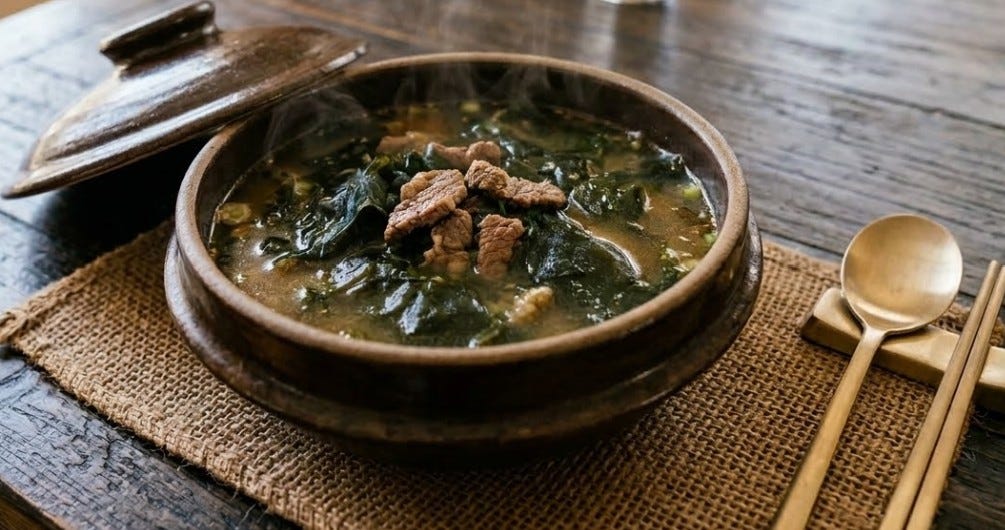
If Korean postpartum care had an official flavor, this would be it. New mothers eat seaweed soup constantly in the weeks after childbirth — not once, not ceremonially, but repeatedly, insistently, devotedly.
The origin story is fittingly beautiful. A widely repeated explanation says that Koreans observed whales, after giving birth, seeking out seaweed to recover, and took that as a cue to feed seaweed to postpartum mothers. Whether this is history, legend, or some mixture of both, it captures something true about the Korean imagination: healing wisdom is often framed as something noticed in the natural world and handed down.
Miyeok, a variety of sea mustard seaweed, is rich in iodine and also contains iron and calcium, which helps explain why it became so closely associated with postpartum recovery. Modern nutritional science supports some of the logic behind the tradition, even if not every traditional claim can be stated so neatly in clinical terms.
A gentle caveat: very high intake over time can raise concerns about iodine excess and thyroid function. The wisdom holds; the quantity may need adjusting.
Korean hospitals serve seaweed soup immediately after delivery. American hospitals, as many Korean mothers in the United States will tell you, do not.
So before my due date, my husband made a large batch of seaweed soup and froze it in portions. When the time came and we drove to the hospital, he packed a thermos of rice and seaweed soup for me to take inside. The hospital food, when it arrived, he ate. I ate the soup from home.
For what it’s worth: I did actually receive reasonably warm hospital food, which is more than can be said for the photos that circulate endlessly in Korean online communities.
The seaweed soup also connects to something beyond postpartum care. In Korea, people eat miyeokguk on their birthdays. Not only cake. Soup. Because the birthday belongs not only to the person being celebrated, but to the mother who brought them into the world on that day — the mother who ate this soup while her body was still recovering. The day of your birth is also the day she endured something enormous. To eat her soup on your birthday is to remember that.
In Korea, the soup of birth became the soup of remembrance.
In this ad, legendary Korean soccer star Ahn Jung-hwan sees his wife making miyeokguk (미역국, seaweed soup) and immediately assumes it must be someone’s birthday. But the punchline is that she is actually making miyeokguk ramen instead. The joke works because in Korea, miyeokguk = birthday is such a deeply ingrained cultural formula that many people instantly make that connection.
When the State Took Notice
The care of postpartum women in Korea was not only a family matter. At certain moments, it became a matter of state.
In 1426, King Sejong — the same ruler who created the Korean alphabet, reformed the calendar, and generally approached governance as an ongoing project of human welfare —granted government-owned female servants one hundred days of postpartum leave. In 1430, he added one month of leave before childbirth, and in 1434, he granted their husbands thirty days of leave so they could help with the care.
In the fifteenth century. In Joseon Korea.
For context: the United States, as of 2026, still has no federal law guaranteeing paid parental leave for all workers, although eligible workers may receive unpaid, job-protected leave under the Family and Medical Leave Act.
One note of historical precision matters here. These protections applied to a specific category of women — those conscripted into government labor. The purpose was not purely humanitarian; labor management was also part of the equation. And the claim that all Joseon noblewomen were automatically relieved of household duties after birth is not clearly supported by primary sources.
What the historical record does show is something narrower, but still significant: the state recognized that the period immediately following childbirth required special protection, codified that recognition into law, and medical literature of the era — including Dongui Bogam (동의보감) — treated postpartum recovery as a distinct and serious clinical category.
The ideal existed. And ideals matter.
Jeju, the Aegi Gudeok, and the Body That Could Not Stop
But the ideal was never the whole story. And if you want to understand the distance between what the tradition promised and what it actually delivered — not in the abstract, not in policy language, but in physical, material reality — you have to look south to the wind-swept volcanic island of Jeju.
While the legal codes in Seoul were debating hundred-day leaves, the women of Jeju were living a different story.
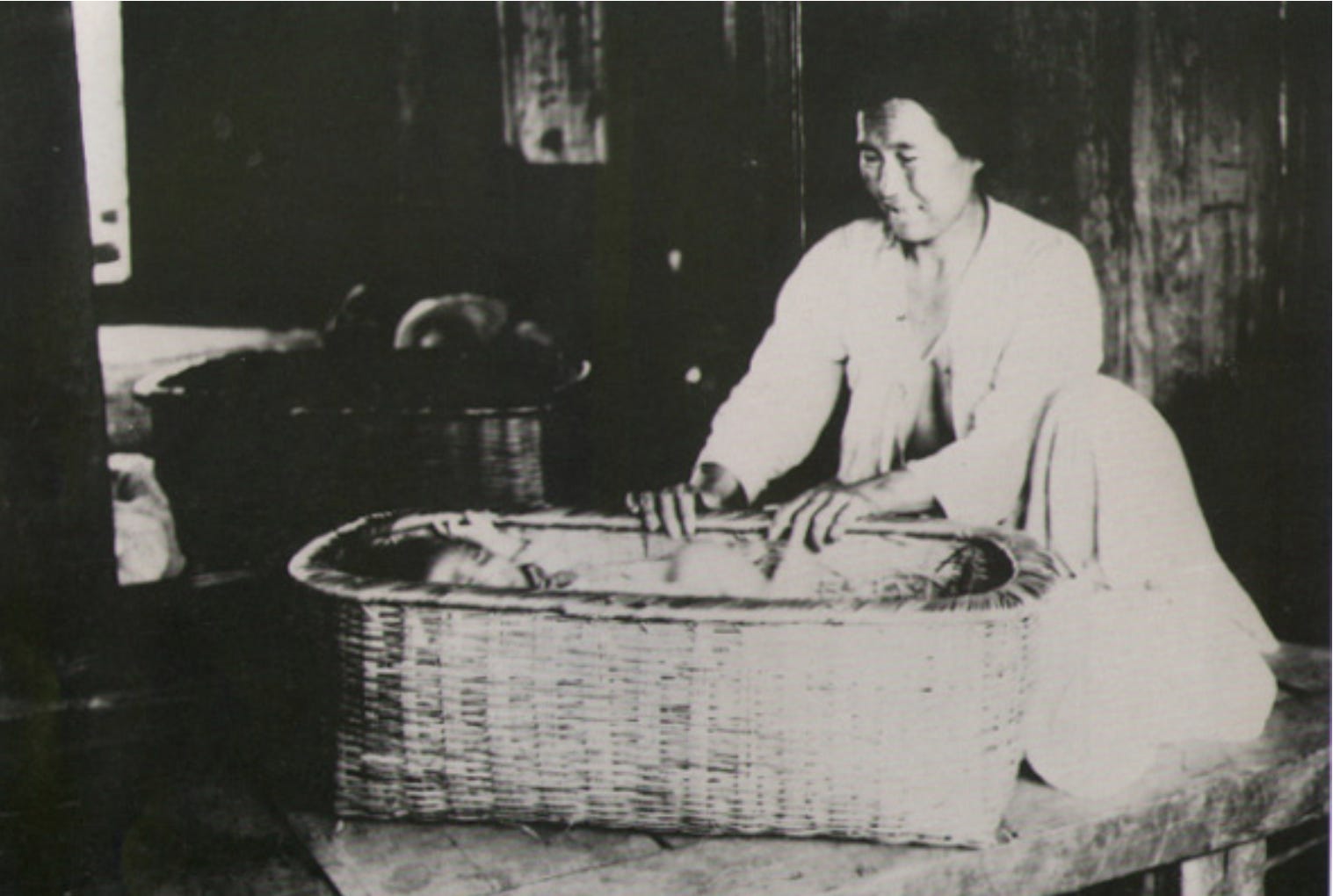
On Jeju Island, there exists a baby cradle found nowhere else in the world. Woven from bamboo in the shape of a deep basket, it is called an aegi gudeok (애기구덕) — literally, “baby basket.” A mother-in-law traditionally gave one to her daughter-in-law before birth. It was light enough to carry on the back, sturdy enough to sit on a furrow between crop rows, and designed to be rocked with one foot while both hands stayed busy with other work.
It was designed, in other words, for a woman who could not stop.
The island depended heavily on women’s labor, especially that of the haenyeo (해녀) — women divers who harvested abalone, sea cucumbers, and sea urchins without oxygen tanks, often diving to around ten meters. In many Jeju households, their work was central to family survival, and UNESCO notes that haenyeo culture advanced women’s status in the community and remains a core part of Jeju identity.
If you’ve watched the Netflix drama 폭싹 속았수다 — When Life Gives You Tangerines — you’ve already seen a version of this world. And if you haven’t, I’d stop and recommend it right now. It’s set in 1960s Jeju, stars IU and Park Bo-gum, and follows a woman named Ae-soon across her entire life. Her mother is a haenyeo, and the drama shows you — in ways that are quietly devastating — what that life actually looked like: the physical toll of diving, the way women built community around each other, the love and the cost tangled together so tightly you can’t separate them. The title in Jeju dialect means something like “You’ve worked so hard.” By the end of it, you understand exactly who that’s being said to.
Two Jeju proverbs survived long enough to be recorded. The first states: “A haenyeo goes back into the sea three days after giving birth, leaving the baby in a basket on the shore.” The second follows from the first: “A haenyeo baby is weaned in seven days.” Not because the mother chose to stop nursing. Because she was already underwater before nursing could take hold, and the baby was given rice gruel instead.
These are not legends. They are descriptions. Oral histories collected from haenyeo in the twentieth century record women who bound their abdomens with rope after delivery and returned to cold water within days.
The aegi gudeok is ingenious. It kept mothers working and kept babies alive. It is also a record of what was not possible. Every basket is, among other things, evidence of a body that did not get to rest.
Korea’s postpartum care tradition may have been widely admired, but the ability to fully practice it was never equally distributed. It was shaped by class, poverty, season, geography, and household circumstances. It was shaped by who had another woman in the house to cook the soup, and who did not. By who could stay in bed and who had to get up anyway.
When Community Becomes Care
That tension between ideal and reality is not only history. My co-writer Jihyun — a mother of two daughters — has her own version of this story.
As we were talking through this week’s topic, she went back and looked at the diary she had kept when her first daughter was born. What came back to her were very specific memories: her husband’s cooking, which she remembered as genuinely delicious, the sheer and relentless volume of seaweed soup she was expected to eat, the warmth of being looked after. But then she got to the part that stopped me.
At the time, Jihyun was the main breadwinner. She was working from home as a comic artist, but the income was hers to carry. Which meant that one week after giving birth, she was back at her desk.
Her friends knew, and they were worried. So they took turns coming over, checking on her, helping out, making sure she could take care of herself a little better.
I think that matters. It shows that sanhujori is not only about soup, or warmth, or ritual. It is also about a social instinct: the recovering mother should not be left alone if people can help it. The old geumjul kept the world out for a while. In modern life, when the world cannot fully stay back — when work calls and bills arrive and life keeps moving — the people who love you try to hold the boundary for you instead.
What This Says About Korea
Still, something is worth noticing here.
For all the jokes that can be made about the socks, the closed windows, and the industrial-scale consumption of seaweed soup, sanhujori rests on an idea that many modern societies have been remarkably slow to honor: a mother needs care too.
In 2022, the World Health Organization published updated guidance on postnatal care, emphasizing that the first six weeks after birth are critical not only for survival, but also for the mother’s physical recovery, mental health, and overall well-being. The American College of Obstetricians and Gynecologists has likewise argued that postpartum care should be treated as an ongoing process rather than a single visit, and has used the phrase “fourth trimester” to describe the challenges of the weeks after birth.
Korea arrived at this conclusion in its own way: through folk ritual, household food, bodily warmth, intergenerational instruction, and centuries of accumulated practice. Some of it is medically elegant. Some of it is culturally intense. Some of it can feel comforting. Some of it can feel oppressive. But taken together, it expresses a striking social belief:
A woman who has just given birth should not simply be congratulated. She should be protected.
That old belief has not disappeared. It has merely changed shape. In contemporary Korea, it now lives not only in grandmothers’ instructions and family kitchens, but in a vast postpartum care industry. According to South Korea’s 2024 national postpartum survey, 85.5% of surveyed mothers used postpartum care centers, with average spending of 2.865 million won (approximately $1,900 USD). The old command to rest has become an infrastructure. And like most infrastructures, it is both comforting and complicated.
That is the story I want to turn to next.
Because in modern Korea, the place where mothers go to recover is sometimes described as heaven.
And sometimes, just as tellingly, as a very expensive kind of captivity.
Beautiful. This is how it should be done! My poor mom got up and went to cooking and taking care of the family. Brutal.
A lovely person on BlueSky introduced me to your blog today and it is wonderful! I found this article to be so interesting and important. I literally almost died having my daughter, and yet I was sent home and expected to bounce back. I guess being an American, my body knew it and complied but it was such an unnecessarily brutal experience. I want to care for my daughter the way Koreans do if she has children one day. Mothers need more than a baby shower. We need genuine care, support and gentleness. Your writing is beautiful, informative and thoughtful. Thank you 🩷