
57. Table for One: Why Eating Alone Became So Complicated in Korea
Honbap can mean freedom, loneliness, or simply a restaurant that still does not know what to do with one person.

Listen to the companion episode: The essay gives you the map. The podcast walks you through the room. Read and listen together for the fuller picture.
There was a time in Korea when eating alone came with a difficulty level.
Not officially, of course.
No government agency issued a National Solo Dining Courage Index, though if any country could produce a beautifully laminated chart for such a thing, Korea would be a strong candidate.
But online, people made lists.
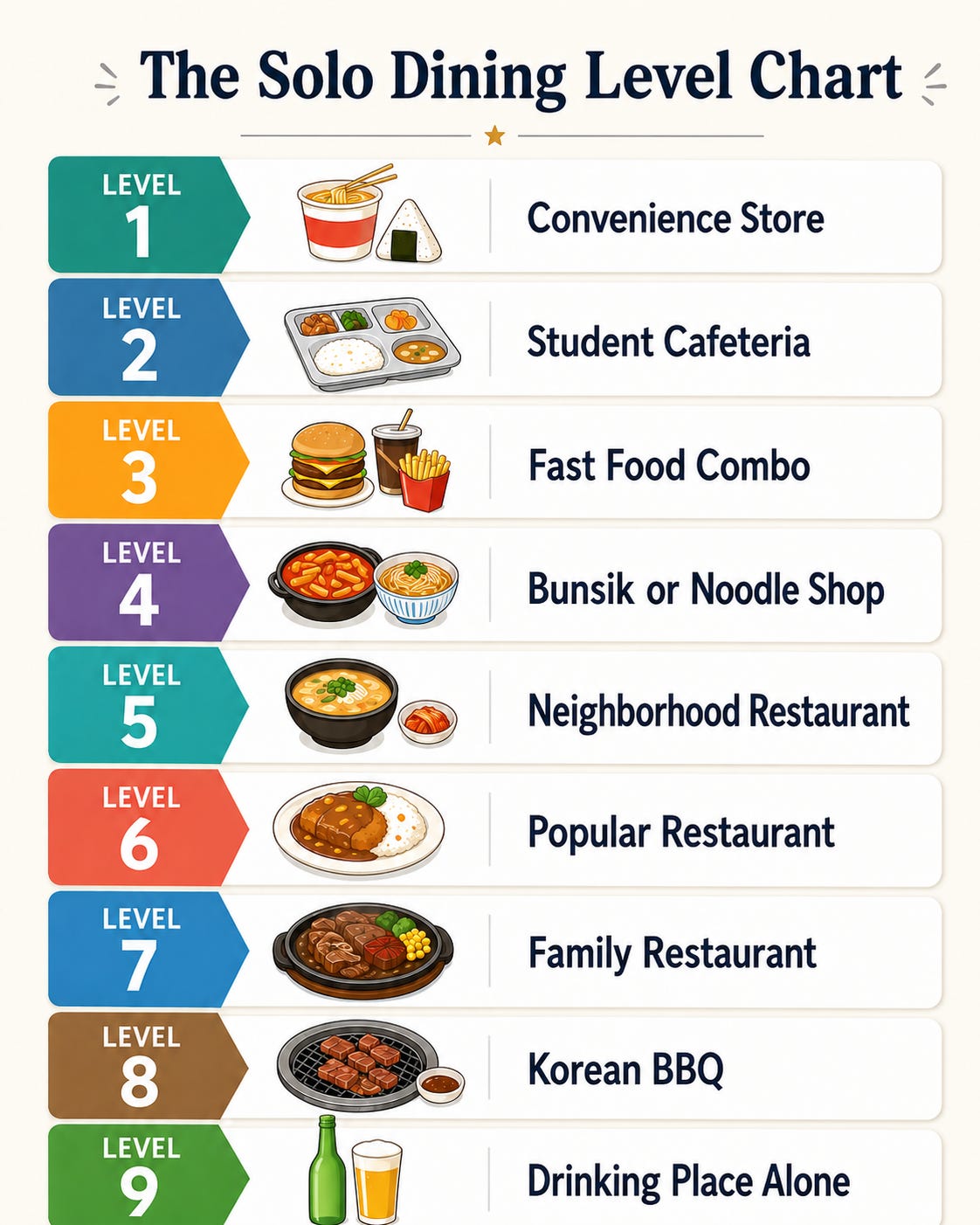
Level 1: eating alone at a convenience store. Safe. Brightly lit. Everyone is just trying to survive on triangular kimbap, instant noodles, and iced coffee.
Level 2: eating alone at a student cafeteria or food court. Also safe. Everyone has a tray. Everyone is moving quickly. No one has the emotional energy to judge your soup choices.
Level 3: fast food. Still easy. Burgers are already individualistic by design.
Level 4: a small noodle shop or bunsikjip (분식집), one of those casual Korean snack-food restaurants where rice cakes, gimbap, noodles, and fried things appear with democratic speed.
Level 5: a regular neighborhood restaurant. Now the stakes rise. There may be side dishes. There may be a server wondering whether you are waiting for someone.
Level 6: a famous restaurant with a line. At this point, eating alone requires not only hunger but confidence. You are taking up space that a group could have used, and the line behind you may have opinions.
Level 7: a family restaurant. Large tables. Shared dishes. Children. Couples. People asking for extra plates. You, alone, facing the full theater of togetherness.
Level 8: a barbecue restaurant. This is advanced. You must grill your own meat, cut it with scissors, manage the lettuce wraps, and confront the terrible existential question: if pork belly sizzles and no one is there to argue about whether it is burning, is it still Korean barbecue?
Level 9: a drinking place. The final boss. Because in Korea, drinking has traditionally been a group activity, complete with pouring etiquette, toasts, snacks, emotional confessions, and at least one person saying, “Just one more round.”
For a while in Korea, eating alone did not feel like a simple choice. It felt like a skill tree.
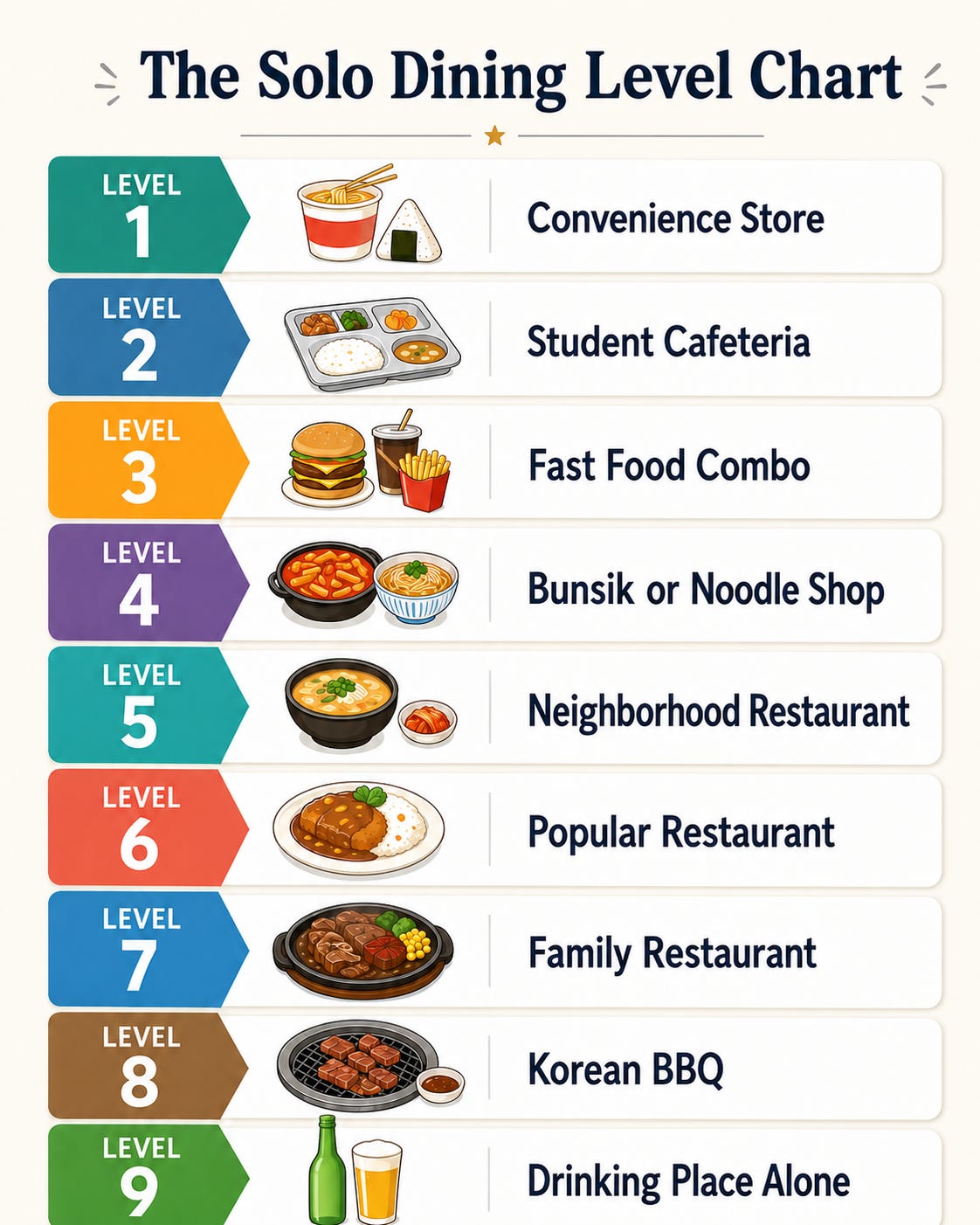
Versions of this ranking system, honbap nan-i-do (혼밥 난이도), literally “the difficulty level of eating alone,” circulated widely on Korean social media in the 2010s. College students debated it. Office workers shared it with knowing nods. Bloggers and solo diners mapped their eating adventures against it like achievement unlocks in a video game.
The fact that eating alone required a difficulty chart tells you something important about Korea.
It wasn’t just a meal. It was a social performance. And performing it alone required a particular kind of nerve.
But here is what has changed.
Honbap (혼밥) — literally “solo rice,” or eating alone — has gone from quiet social embarrassment to something approaching a cultural institution. From a thing people did while hoping no one noticed, to a thing with its own restaurants, menus, infrastructure, and, as we’ll see next week, its own literature.
This week: the transformation. How it happened, what it means, and why a CNN journalist being turned away from a Seoul restaurant twice in one day became an international food-culture story.
“We Don’t Serve Loneliness”
In May 2026, CNN Travel published a piece by Maggie Hiufu Wong that gave this old awkwardness a very current scene.
Wong writes about standing outside a half-empty restaurant in Seoul, asking for a table for one, and being turned away. It was not even the first restaurant to refuse her that day. The article also describes a controversy over a Seoul noodle restaurant that reportedly told solo diners to either order for two or “bring a friend or spouse.” The sign, according to the article, said: “We don’t serve loneliness.”
That sentence is almost too perfect.
Cruel, yes.
But culturally revealing.
Because what it really says is not only: we do not serve one-person tables.
It says: our restaurant is built around a certain imagination of eating, and in that imagination, food arrives with company.
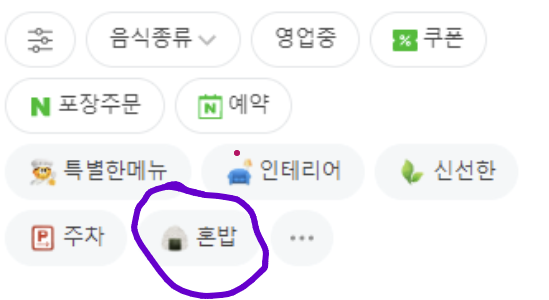
In the same CNN Travel article, Hong Kong-based food and travel writer Gloria Chung Wing Han points out that dining alone in South Korea can actually be surprisingly easy if you know where to look. Business districts like Gangnam or Jongno, noodle shops, and casual local eateries often work well for solo diners. The article also notes that Naver Maps now lets users search for places friendly to solo diners.
That detail matters.
A culture does not change only when people change their minds.
It changes when maps change.
Menus change.
Chairs change.
Apps change.
And the search filter finally admits: yes, this person exists.
So Korea is not simply a country where solo diners are rejected. That would be too simple. Korea is a country where solo dining has become normal, commercialized, accommodated, and still sometimes awkward.
This recent Yonhap News clip shows that the tension is still alive. Posted on May 8, 2026, the Korean-language segment examines “no-honbap zones,” restaurants that discourage or refuse solo diners during busy lunch hours. Reporters called 100 restaurants in Seoul office districts and found that 15 would not accept a party of one at lunchtime, citing limited seats, peak-hour turnover, or two-person minimums. The table for one has arrived, but Korea is still negotiating where to put it.
In other words, Korea is doing what Korea often does best: moving very quickly while still carrying an older emotional operating system in its pocket.
When Eating Alone Needed Courage
To understand honbap, you first have to understand the Korean gaze.
Koreans have a word that comes up again and again in everyday life: nunchi (눈치). It is hard to translate perfectly, but “social radar” gets close. It means the ability to read the room, sense the mood, and understand what others expect without anyone saying it directly.
As I wrote in last week’s essay on the Korean table, nunchi is often learned and sharpened at the table. Children learn who eats first, who serves whom, when to speak, when to wait, and whether taking the last piece is confidence, carelessness, or a social emergency.
Nunchi is useful. It can make people attentive and considerate.
It can also make a sandwich feel like a public performance.
If you grow up in a culture where meals are often social, where lunch at work can mean eating with coworkers, where family meals are a way of checking whether everyone is okay, then eating alone does not automatically feel neutral.
It may feel efficient.
It may feel peaceful.
It may feel embarrassing.
It may feel like relief under bright fluorescent lights.
The old honbap difficulty charts were funny because they captured that social tension.
A convenience store was easy because no one expected intimacy there. Everyone is already passing through. You buy your triangular kimbap, maybe a cup of instant noodles, maybe a banana milk if you are in the mood, and sit under the bright lights. No one asks too much from you.
A food court is also manageable. Everyone is scattered. Trays move quickly. Strangers are already strangers.
But a barbecue restaurant?
A drinking place?
That was different.
Those were built for groups.
The table itself expected other people.
The empty chair became part of the meal.
When a Quiet Lunch Looked Like a Warning Sign
A reader named Richard knows this feeling from the other direction.
Richard is a British teacher who spent over a decade working in Korean middle schools. He wrote in response to last week's piece, and what he described captures the emotional logic of the Korean shared table better than any statistic could.
Whenever he quietly chose to eat lunch alone, something predictable would happen:
“Most days I ate with the other teachers in my department, but, being British, every now and again I felt the need for some alone-time and would sit on my own to eat my lunch. This would always elicit colleagues and students approaching me throughout the rest of the day to ask me if I was OK.”
In a follow-up comment, he added that the first time someone asked, “Is everything OK with you, are you struggling?” simply because he was sitting alone at lunch, it caught him off guard. But over time, he came to understand it differently:
“I quickly realised it was a form of cultural caring that was actually very authentic.”
That is the exact emotional knot of honbap.
What felt to Richard like a quiet lunch could be read by others as a sign that something was wrong. The concern was real. It was even tender. But it also shows why eating alone once required a certain kind of courage. In a culture where eating together often means care, eating alone can look like the absence of care.
Richard also remembered going alone to a local pojangmacha (포장마차), a casual street-food-and-drinking stall, and being invited over by local ajeossi (아저씨), middle-aged men, to share a glass of soju.
I love this detail because it shows the other side of the Korean shared-table instinct. Eating alone was not only judged. Sometimes it was absorbed. The table simply widened.
Richard also noticed that this changed over time. When he first experienced it in 2007 or 2008, eating alone still drew concern. By the time he left Korea in 2018, it felt more normal. But he added an important point: the change was not evenly distributed. In some parts of Seoul, no one would blink at a person eating alone. In regional towns, he felt people might still be more surprised, and fewer places were set up to make solo dining easy.
That geographic detail matters. Honbap did not arrive everywhere in Korea at the same speed. Seoul often changes first. The infrastructure follows: counters, single-person menus, app filters, and restaurants designed to make one person feel less like an exception. But outside those spaces, the older emotional logic of the shared table can still remain stronger.
Which brings us to the larger shift behind Richard’s experience.
The Numbers Behind the Table for One
Korea has changed.
The solo diner is no longer an unusual figure at the edge of the room. Increasingly, the solo diner is the room.
In 2000, one-person households made up 15.5 percent of South Korean households. By 2024, according to Korea’s Ministry of Data and Statistics, that figure had reached 36.1 percent, or about 8.04 million households.
This is not a small lifestyle shift.
It is a structural change.
It means more people wake up alone, decide meals alone, shop alone, clean up alone, and fall asleep with no one else in the next room.
Of course, living alone does not automatically mean loneliness.
Some people living alone are surrounded by friends, coworkers, lovers, pets, group chats, church communities, running clubs, fitness classes, and at least one family member who texts too often.
And some people living with others are lonely enough to feel invisible in their own kitchen.
Still, the rise of one-person households changes the practical structure of daily eating. If no one else is at home, dinner becomes a personal decision. If work schedules do not line up, lunch becomes private. If school, commuting, overtime, study, and fatigue scatter the day, the shared table becomes harder to maintain.
And once enough people eat alone, society begins to build around them.
Restaurants add counter seats and partitions.
Convenience stores expand their lunch boxes.
Delivery apps promote one-person portions.
Supermarkets sell smaller packages.
Companies quietly accept that the person in the cafeteria corner with headphones may not be sad. They may simply be protecting the only 35 minutes of the day that belong to them.
This is where honbap becomes interesting.
Because eating alone in Korea did not simply become common.
It became reinterpreted.
Honbap as Freedom
For many younger Koreans, honbap is not failure.
It is freedom.
It is the freedom to choose the menu without forming a temporary parliament.
It is the freedom to eat spicy food without checking whether everyone else can handle it.
It is the freedom to eat slowly.
Or quickly.
Or while reading.
Or while watching something.
Or while saying absolutely nothing, which can be a deeply underrated form of luxury.
For office workers, especially, lunch can be the only small island inside the workday.
Work in Korea has often been highly social, sometimes too social. There is the lunch group. The team dinner. The after-work gathering. The polite laugh. The careful listening. The constant need to sense the mood.
So the desire to eat alone is not necessarily antisocial.
Sometimes it is social exhaustion with chopsticks.
This matters because Korean meals, as we saw last week, have often been relational. You notice others. You offer food. You wait. You share. You adjust. You read the room.
But sometimes, a person does not want lunch to be a miniature ethics exam.
Sometimes, a person wants to eat soup and not perform being agreeable.
Sometimes, the most radical sentence in the Korean workday is:
I’ll eat alone today.
Not dramatic.
Not rude.
Just enough.
A tiny declaration of bodily sovereignty, served with rice.
The Infrastructure of Eating Alone
As honbap became more common, Korean businesses adapted.
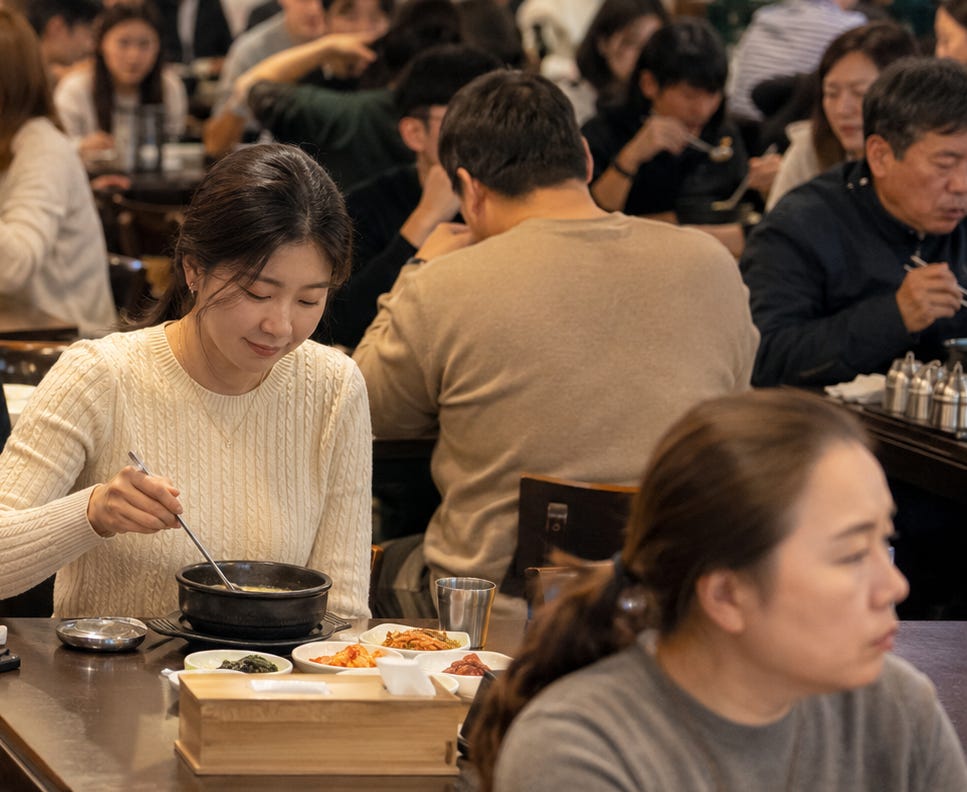
Convenience stores began offering more substantial lunch boxes and ready-made meals. Restaurants experimented with solo seating. Some places created partitions so one person could eat without the awkward theater of being visibly alone. Food companies developed smaller packages for one-person households. Delivery apps made it easier to order one portion.
This is often described as the rise of the “single economy.”
That phrase sounds clean and businesslike.
But what it really means is that the old assumption — that food is prepared, sold, served, and eaten by groups — no longer matches the way many people live.
The CNN Travel article places Korea inside a larger global shift too. According to OpenTable data cited in the article, solo dining increased worldwide in 2025, outpacing other party sizes. The article also suggests that restaurants may be missing an opportunity when they treat solo diners as a problem rather than as valuable customers.
That is the tension at the heart of solo dining now. Culturally, one person at a table can still feel awkward to some restaurants. Economically, that same person is becoming harder to ignore.
The market noticed what the table had already been telling us for years.
More people were eating alone.
More people needed food scaled to one person.
More people wanted to eat without explaining themselves.
In this sense, honbap became normalized not only through attitude change, but through infrastructure.
A person can only choose freely when the world around them makes that choice possible.
If every restaurant requires two servings, eating alone is not just socially awkward. It is expensive.
If every table is built for groups, the solo eater becomes a problem of furniture.
If every lunch invitation is treated as compulsory, eating alone becomes rebellion.
But when the city begins to offer counters, convenience stores, small portions, delivery options, and solo-friendly spaces, something changes.
The person eating alone becomes not an exception, but a customer.
That is not the same as belonging.
But it is a form of recognition.
Honbap as Loneliness
But honbap is not always liberation.
This is where the story becomes more delicate.
Eating alone by choice can feel like freedom.
Eating alone because there is no one to eat with can feel like abandonment.
The same meal can carry completely different meanings depending on the life around it.
A college student eating alone between classes may feel efficient.
A young worker eating alone after a brutal day may feel relieved.
A freelancer eating alone at home for the seventh lunch in a row may begin to feel the walls getting too familiar.
An older person eating every meal alone may not call it honbap at all. It may simply be what is left after a spouse dies, children move away, friends grow ill, and the neighborhood table disappears.
This is why we have to be careful not to make honbap into a simple trend story.
It is not only cute convenience-store lunch.
It is not only the cool independence of the young urban single.
It is not only a stylish woman eating pasta alone in a drama, emotionally lit by a window.
Sometimes it is self-care.
Sometimes it is time poverty.
Sometimes it is class.
Sometimes it is grief.
Sometimes it is what happens when no one notices whether you ate.
The 2025 World Happiness Report found that people who share more meals with others report higher life evaluations, more positive affect, and less negative affect across many countries and cultures. The report is careful about causality, and we should be too. We cannot simply say that eating with others makes people happy, because happier people may also have more opportunities to eat with others.
But the association is striking.
A meal is one of the simplest ways human beings turn time into relationship.
When that disappears, something can disappear with it.
In Korea, this issue is especially poignant.
Reporting on the 2025 World Happiness Report noted that Koreans and Japanese shared meals least often among G20 countries.
At the same time, South Korea has been paying growing attention to godoksa (고독사), lonely deaths — cases in which people living in social isolation die without immediate contact with others. In 2023, the number of lonely deaths in Korea reached 3,661, according to data compiled by Korea’s Ministry of Health and Welfare.
To be clear, honbap does not cause lonely death.
Eating alone is not a pathology.
But repeated solo meals can become one of the places where isolation becomes visible, especially among people whose lives lack other forms of care.
This is why honbap has to be read with tenderness.
The question is not: is eating alone good or bad?
The better question is: what kind of alone is this?
Chosen alone?
Forced alone?
Peaceful alone?
Exhausted alone?
Invisible alone?
The answer changes everything.
A Table for One Is Still a Table
So what do we do with honbap?
I think we start by refusing to flatten it.
We should not romanticize the old shared table as if every group meal was warm and generous. Many people escaped those tables for good reasons: hierarchy, body comments, forced drinking, awkward coworkers, family tension, and the exhausting labor of being observed.
At the same time, we should not celebrate solo eating as if independence solves everything. Being free from other people can be wonderful. Being abandoned by other people is not.
The difference is not always visible from the outside.
Two people may sit alone at two neighboring tables.
One may be quietly happy.
The other may be trying not to cry into soup.
This is why honbap requires a gentler vocabulary.
Not judgment.
Not pity.
Not trend worship.
Discernment.
Is this person alone because they want peace?
Because they need rest?
Because they cannot afford to eat out with others?
Because work has eaten the lunch hour?
Because everyone they loved is gone?
Because eating alone is the one small place where they feel like themselves?
Each answer asks for a different kind of response.
Sometimes the response is: leave them alone.
Sometimes it is: invite them, but leave them room to say no.
Sometimes it is: build restaurants where one person can eat without shame.
Sometimes it is: create policies so older people do not disappear behind closed doors.
Sometimes it is: protect the lunch break as a human need, not a decorative workplace perk.
And sometimes it is as simple as saying, without making it weird:
Have you eaten?
A table for one is still a table.
It can be a shelter.
It can be a symptom.
It can be a small act of self-respect.
It can be a warning light.
It can be lunch.
Just lunch.
Which, in Korea, is almost never just lunch.
Next week, I want to stay with lunch itself — that strange middle of the day.
Because honbap did not only lead to convenience-store meals, delivery options, and app filters.
It also made room for literature.
There is a Korean essay collection written for people who eat lunch alone.
And sometimes, a book is also a kind of table.
Love this piece. I think there are so many reasons why people want to or don’t want to eat alone. Interesting to read the Korean perspective and yes it is indeed complicated!
As a woman who often travels alone and loves good food, I realize I’m going to have to brace myself for Seoul. But in other cities I’ve had trouble too: London on a Saturday night was impossible. They’d put me on the list, leave me sitting for an hour while they seated drop-ins, and never tell me why!