
56. “Did You Eat?”: The Three Words That Explain Korean Culture
Before honbap, mukbang, and delivery apps, there was a table. And the table was never just about food.

🎧 Companion podcast episode: Not just a reading of this essay, but the banchan on the side. The newsletter gives the main argument; the podcast adds stories, examples, and extra Korean words. Read and listen together for the whole table.
In Korea, when someone you care about is going through a hard time, a bad day, a breakup, or a week that has simply been too much, the most natural thing to say is often not, “Are you okay?”
It is, “밥 먹었어?”
“Did you eat?”
The first time a non-Korean hears this, it can land strangely. Did I eat? That is your question?
But sit with it for a moment. Because in Korean, that question is almost never only about food.
Bap Is Not Just Rice
When Koreans ask, “밥 먹었어?” (bap meogeosseo?), bap (밥) technically means rice. But in everyday Korean, it also means meal. Any meal. All meals.
When a mother texts her child in college at 11 p.m. asking, bap meogeosseo?, she is not conducting a nutritional survey. She is asking: Are you taking care of yourself? Is someone taking care of you? Are you still okay out there?
This is how care often gets expressed in Korean.
Not always in the language of feelings, which can be hard to say out loud, but in the language of food, which is safer, humbler, and more immediate.
Babeun meokgo danyeo? (밥은 먹고 다녀?)
Are you eating these days?
This is what you ask a friend who is going through something difficult.
Mworado meogeoyaji. (뭐라도 먹어야지.)
You should eat something.
This is what you say when someone looks as if they are falling apart.
Eonje bap hanbeon meokja. (언제 밥 한번 먹자.)
Let’s eat together sometime.
This is sometimes a real plan, and sometimes a way of saying: I do not want to lose touch. Let’s not let this become a goodbye.
In Korean, asking about a meal is asking about a life.
To ask about someone’s bap is to ask about their body. And to ask about their body is to ask, however indirectly, about their heart.
A clip from the Korean film talk show Movie Room (Bangguseok 1 Yeol, 방구석 1열) discussing one of the most famous lines from Bong Joon-ho’s Memories of Murder (Salinui Chueok, 살인의 추억): “밥은 먹고 다니냐?” (Babeun meokgo danyeo?, “Are you eating these days?”). In the film, a detective asks this question to the man he has been chasing as a murder suspect. The line has inspired many interpretations because it sounds, impossibly, like care, exhaustion, pity, and moral defeat all at once.
Sikgu: The Family That Eats Together
There is a Korean word for family that quietly says everything: sikgu (식구).
It is usually translated as “family,” but that is not quite enough. The word is made of two Chinese characters: sik (食), meaning “to eat,” and gu (口), meaning “mouth.” Literally, sikgu means “eating mouths.” More naturally, it refers to the people who live together and share meals. KBS World explains that while gajok (가족) refers to a family formed through marriage, blood, or legal ties, sikgu refers to people who live in the same house and eat meals together.
This distinction matters.
In English, “family” often begins with blood, marriage, adoption, or legal structure. In Korean, sikgu begins with eating.
Not abstract belonging.
Not paperwork.
A meal.
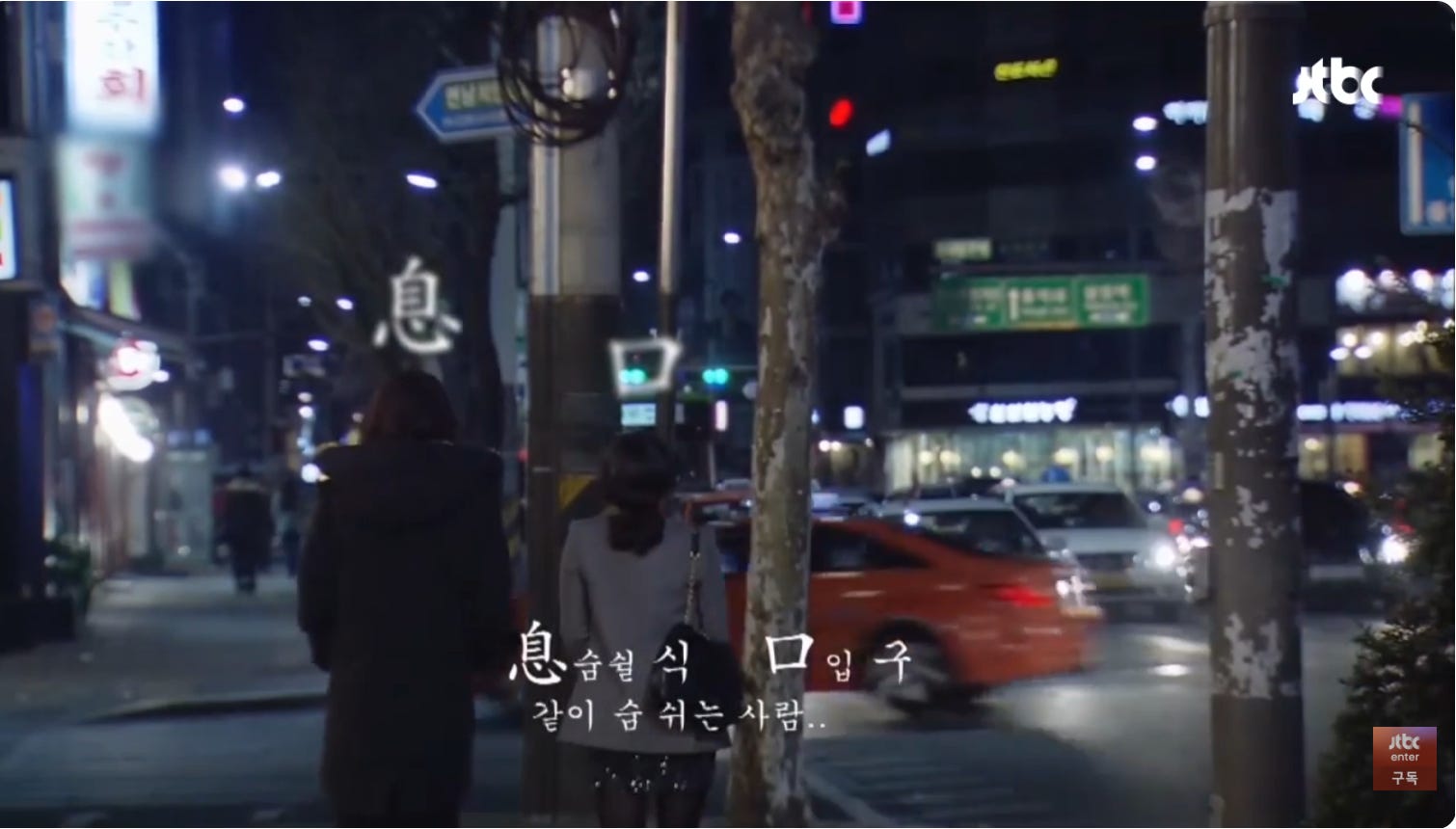
A Korean book I have been reading, Eating, Not Mukbang, Not Food Pics (먹방 말고 인증샷 말고 식사), makes a lovely comparison. In French, the word copain, friend or companion, is often traced to the idea of someone with whom one shares bread. In Korean, sikgu gives us a similar idea: the people who eat together are not just people near us. They are people bound to us through the repeated act of sharing food.
Of course, actual Korean families have always been shaped by law, bloodline, gender, class, inheritance, and obligation. I am not suggesting Korea had some innocent rice-based utopia where everyone simply passed kimchi and loved one another. Korean family life, like family life anywhere, can be warm, complicated, suffocating, generous, painful, and all of these before breakfast.
But linguistically and culturally, sikgu reminds us that eating together has been one of the main ways Koreans have imagined belonging.
A person becomes part of your life not only because you know their name, but because you know how they eat.
Do they like their rice a little dry or soft?
Do they reach for kimchi first?
Do they put too much gochujang (a spicy-sweet Korean red chili paste) in everything and then pretend they are fine?
Do they leave the mushrooms behind and hope no one notices?
At the Korean table, intimacy often arrives through these small observations. You learn people not only through what they say, but through what they reach for.
A Table Built for Sharing
A traditional Korean meal is not usually organized around one self-contained plate per person.
There are individual elements, yes. Each person usually gets their own bowl of rice and often their own soup. But much of the meal lives in the center: banchan (반찬), the small side dishes; a bubbling jjigae (찌개), stew; a grilled fish; a platter of meat; lettuce leaves for wrapping; sauces; kimchi. KOCIS describes the Korean table as one where rice, side dishes, and soup or stew come together, with people often viewing a meal as complete only when it includes rice, soup, side dishes, a spoon, and chopsticks.
As I wrote last week in my review of Joo Young-ha’s Why Do Koreans Eat Like This?, the Korean table unfolds in space, not time. The Korean term for this full spread is hansang charim (한상차림), literally a whole table setting: rice, soup, side dishes, and often a shared main dish laid out together.
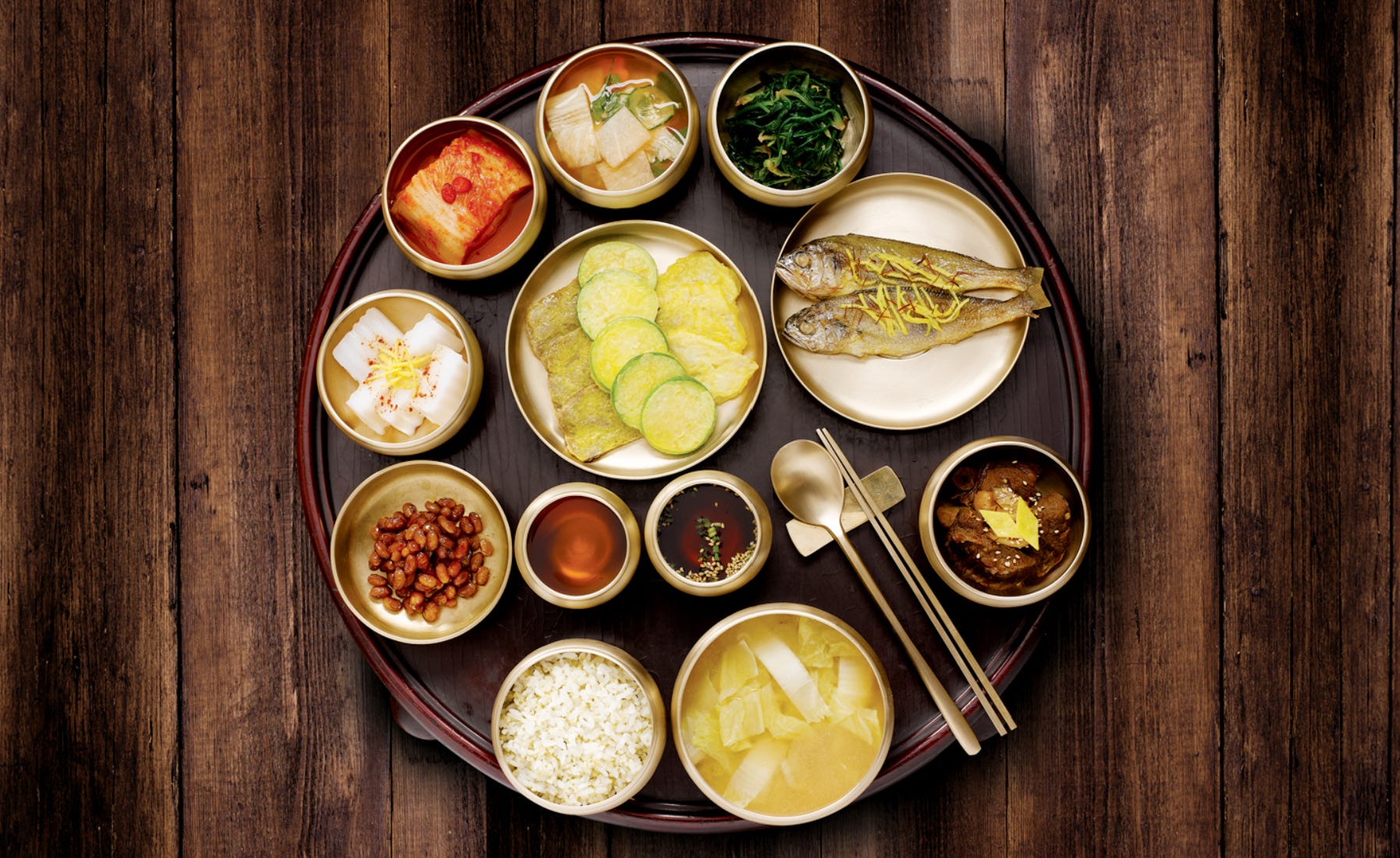
In many Western meals, dishes often arrive in sequence: appetizer, main course, dessert. The meal moves forward. But a Korean table tends to appear all at once, spread out across the surface before you. The eater does not move through courses so much as move across the table.
This structure is very different from the classic Western plate, where your food arrives as a kind of private nation-state: your steak, your potatoes, your vegetables, your sauce, all contained within a border.
The Korean table is more like a small, edible commons.
There is my rice and your rice.
But there is our kimchi.
Our stew.
Our grilled pork.
Our little dish of seasoned spinach that somehow disappears faster than expected.
This does not mean Koreans have no sense of personal space. It means the meal itself has often been designed around a moving boundary between “mine” and “ours.”
A Korean table asks you to negotiate.
You watch the pace of others. You notice if someone has not tried the fish. You offer a piece of meat. You say, “Try this.” You wrap rice, meat, garlic, ssamjang, and kimchi in a lettuce leaf and hand it to someone, which is either an act of love or a minor logistical challenge, depending on how much garlic you put in there.
Many Korean foods can be eaten alone. But many of them make the most cultural sense when they are shared.
Korean barbecue is the clearest example. Technically, one person can grill pork belly alone. Spiritually, however, the grill looks slightly confused.
The whole point is the rhythm: someone turns the meat, someone cuts it with scissors, someone says, “It’s burning,” someone else says, “No, it’s perfect,” and everyone pretends there is a single correct answer to how crispy pork belly should be.
The same is true for jeongol (전골), hot pot, or budae jjigae (부대찌개), or a large plate of tteokbokki shared after school. The taste is not only in the food. It is in the traffic around the food.
This is one reason honbap (혼밥), eating alone, became such a loaded idea in Korea. Eating alone did not simply mean removing other people from the table. It meant stepping outside a whole grammar of eating: offering, refusing, noticing, waiting, yielding, urging, and sharing.
The Dinner Table as Classroom
Ask a Korean parent about bapsangmeori gyoyuk (밥상머리 교육), literally “education at the head of the dining table,” and you will often get a knowing nod.
It refers to what children learn while eating with family: manners, speech, emotional cues, respect for elders, conversation, restraint, care.
The table becomes a classroom, but without desks, grades, or the chance to raise your hand and say, “May I be excused from intergenerational hierarchy today?”
The idea that shared meals help children is not only Korean. Researchers in the United States and elsewhere have studied family meals for decades. A Harvard Graduate School of Education interview with Anne Fishel, co-founder of The Family Dinner Project, summarizes research linking family dinners with benefits in nutrition, mental health, academic performance, and family connection.
But in Korea, this general idea takes on a particular cultural force because the meal has so often been treated as a site of social formation.
You do not only eat rice.
You learn when to speak.
You learn how to listen.
You learn how to read the room.
That last one is important. Koreans call it nunchi (눈치), a kind of social radar. It means noticing what is going on without being told directly. At the table, nunchi is everywhere.
Is the oldest person eating?
Is there enough meat left?
Did someone refill the water?
Did someone quietly avoid the anchovies?
Should you offer the last piece of pajeon (a savory Korean scallion pancake), even though you have been emotionally committed to it for the past twelve minutes?
The Korean table trains you in the art of watching.
This can be beautiful. It can make people attentive. It can produce forms of care that are small but deeply felt. Someone puts the good piece of fish on your rice. Someone saves you the last sweet potato. Someone notices you are eating less than usual and asks what is wrong.
But it can also be exhausting.
Because when everyone is watching, you are being watched too.
A small note of caution: family meals are not magic. Their effects vary enormously depending on economic conditions, parents’ time, work schedules, stress, and what actually happens at the table. A tense, critical dinner is not better than eating alone.
But the aspiration, the idea that the shared meal was worth protecting, was very real in Korean culture. And it shaped how people thought about food and family for generations.
But the Table Was Never Only Warm
Before we go further, before we get to honbap and the freedom it sometimes represents, we should be honest about something.
The shared Korean table was not always an uncomplicated source of warmth.
It was also a place of observation.
At a Korean table, you do not always simply eat. You are also seen eating.
You do not pour your own drink, which means someone is always watching what you are drinking, and how much. You notice who is not eating. You comment.
Wae ireoke an meogeo? (왜 이렇게 안 먹어?)
Why are you eating so little?
Saljjyeonne. (살쪘네.)
You’ve gained weight.
Igeotdo meogeobwa. (이것도 먹어봐.)
Eat this too.
That last one is often offered with genuine love, and sometimes with absolutely no awareness that the recipient did not ask to be assigned three more side dishes.
At a Korean table, the hierarchy of the household is performed through who sits where, who serves whom, who waits for the elder to lift their chopsticks before beginning, who can speak freely, and who holds back.
The warmth is real.
And so is the weight.
This dynamic did not stay at home. It followed Koreans to work.
Then there was hoesik (회식), the Korean workplace dinner. Traditionally, hoesik was framed as a team-bonding event, a way for coworkers to eat, drink, and become closer outside the formal structure of the office. In practice, it often functioned as a performance of loyalty and hierarchy. The menu might be chosen by the most senior person present. The toasting order could follow rank. Attendance was theoretically optional. Declining was theoretically fine. Everyone understood that both of those things could be somewhat theoretical.
That said, hoesik culture is not frozen in the 1990s. In recent years, especially after the pandemic and with younger workers pushing harder for work-life balance, Korean workplace dinners have changed. Many gatherings are shorter, less alcohol-centered, or end after the first round. Some younger office workers now prefer daytime team meals over late-night drinking, and more people feel social permission not to drink.
But the older logic still matters because it shows how easily a shared meal can become more than a meal. At home, the table taught hierarchy through who waited, who served, and who spoke. At work, hoesik carried a similar grammar into the company dining room.
Korean meals were held together by care and by obligation, by warmth and by surveillance, often simultaneously.
The person who made sure you ate was also the person who noticed everything you ate.
The food was love.
The table was also a kind of ledger.
New to the concept of hoesik (회식), the workplace dinner that is never just dinner? This? This clip from the SBS drama Love Scout (My Perfect Secretary, 나의 완벽한 비서) shows what it actually looks like when a Korean office finally, reluctantly, then enthusiastically, embraces the workplace dinner. Consider it a field guide.
Real hoesik varies wildly: some are tense loyalty performances, some are genuinely fun, and some are both within the same evening. This one leans toward the fun end. Don’t let it fool you into thinking it’s always this chill. But also, sometimes it really is.
The Family That Lives Together, But No Longer Eats Together
Here is something that has shifted, quietly and quickly, over the last few decades.
The Korean book Eating, Not Mukbang, Not Food Pics (먹방 말고 인증샷 말고 식사) describes the current reality with uncomfortable precision: breakfast is skipped, lunch is eaten as fast as possible, and dinner is scraped together. Students rush through crowded school cafeterias between classes and study sessions. Parents work hours that do not fit around family dinners. Schedules diverge: school, work, after-school programs, night shifts. The family that used to gather around one table finds that it can no longer reliably find a single hour in common.
Sikgu, the eating mouths, the people who shared your rice, is a concept that requires time.
It requires repetition.
You become someone’s sikgu not through one meaningful dinner, but through ten thousand ordinary ones: the Tuesday evening meals, the rushed Saturday breakfasts, the late nights when everyone is tired and the soup is just reheated.
When that time disappears, something changes.
Not the love, necessarily. But the knowledge that comes from watching someone eat.
Knowing which dishes they always finish first.
Knowing when they are upset because they have barely touched their food.
Knowing without being told that something is wrong.
That knowledge requires proximity.
And proximity requires meals.
Families are still families. But the sikgu, the shared table, the eating mouths, is becoming harder to maintain.
The 2025 World Happiness Report found that sharing meals with others is strongly associated with higher life evaluations, increased positive affect, and decreased negative affect across countries and cultures. This is a correlation, not a cause. It is impossible to say simply that eating together makes people happy, since the relationship almost certainly runs in both directions. But the pattern is striking.
Korea makes this especially poignant. According to reporting on the same report, South Korea ranked near the bottom globally in the frequency of shared meals, with Koreans and Japanese sharing meals least often among G20 countries.
Meanwhile, the structure of Korean households has changed dramatically. In 2024, one-person households reached 8.04 million, or 36.1 percent of all households in South Korea. In 2023, the number of godoksa (고독사), or lonely deaths, reached 3,661, according to data compiled by Korea’s Ministry of Health and Welfare.
Something shifted.
And the dinner table is one of the places where you can see it most clearly.
The Table That Was Always Changing
One more thing is worth saying before we move on.
The warm, communal Korean dinner table, everyone gathered together, multiple generations, the whole family around one low table, is, in some ways, a modern image.
That does not make it fake. It makes it historical.
In the Joseon dynasty (1392–1910), meals were often governed by hierarchy. Men and women could eat separately. Elders ate first, sometimes alone or in order of rank. The doksang (독상), an individual tray set for one person, was common in formal settings. Sitting together at one table, gyeomsang (겸상), was not always the norm. It became more common as rigid social orders changed, as urban housing changed, and as the modern nuclear family took shape.
The nostalgic image of the Korean family around one table is real, and it matters.
But it is younger than it looks.
And if it could be created, it can also be unmade.
This matters because nostalgia can trick us. It can make us imagine that the “traditional Korean table” was always warm, equal, abundant, and shared. But Korean food culture, like Korea itself, has changed again and again.
What remained powerful was not one fixed table arrangement.
It was the idea that eating revealed relationships.
Who eats first.
Who eats together.
Who eats alone.
Who is fed.
Who is expected to feed others.
Who notices.
Who is noticed.
The table was never only furniture.
It was social structure.
What the Table Held
Korean food, at its best, was built for the pleasure of the table, not just the pleasure of eating.
This distinction matters.
The pleasure of eating is personal: the taste, the texture, the satisfaction of hunger met. It belongs to you alone, and you can have it anywhere, eating anything, by yourself.
But the pleasure of the table requires others.
It requires the person who slides a dish toward you before you have asked.
The conversation that makes the meal last longer than it needed to.
The moment when everyone reaches for the last piece at the same time, and someone laughs, and someone gives it to someone else.
This is what Korean food culture was structured around. Not just nourishment. Not just flavor. The meal as a relational act. The table as a place where family and community were rehearsed, confirmed, strained, and sustained.
Honbap did not arrive from nowhere.
It was not invented by a generation that does not know how to connect, or by social media, or by delivery apps.
It emerged from a society where eating together was so loaded, with meaning, care, hierarchy, obligation, surveillance, and love, that eating alone became, for many people, something that felt like freedom.
To understand Korean honbap, you first have to understand what Koreans were sitting at when they decided they needed a table of their own.
That table was not just a surface for food.
It was an entire social order.
Next week: the rise of honbap, what it means to eat alone in a country where eating alone was once almost unthinkable, and why a whole infrastructure of culture, architecture, and technology grew up to make it possible.