
61. Dinner Will Find You
The History and Hidden Infrastructure of Korean Food Delivery

🎧 Companion Podcast: This episode is not a reading of the essay. Think of it as the audio side dish. The newsletter follows the history and hidden infrastructure of Korean food delivery; the podcast follows the feeling of the meal. Read and listen together for the full picture.
If you have never been to Seoul, I want you to start at the Han River on a summer evening.
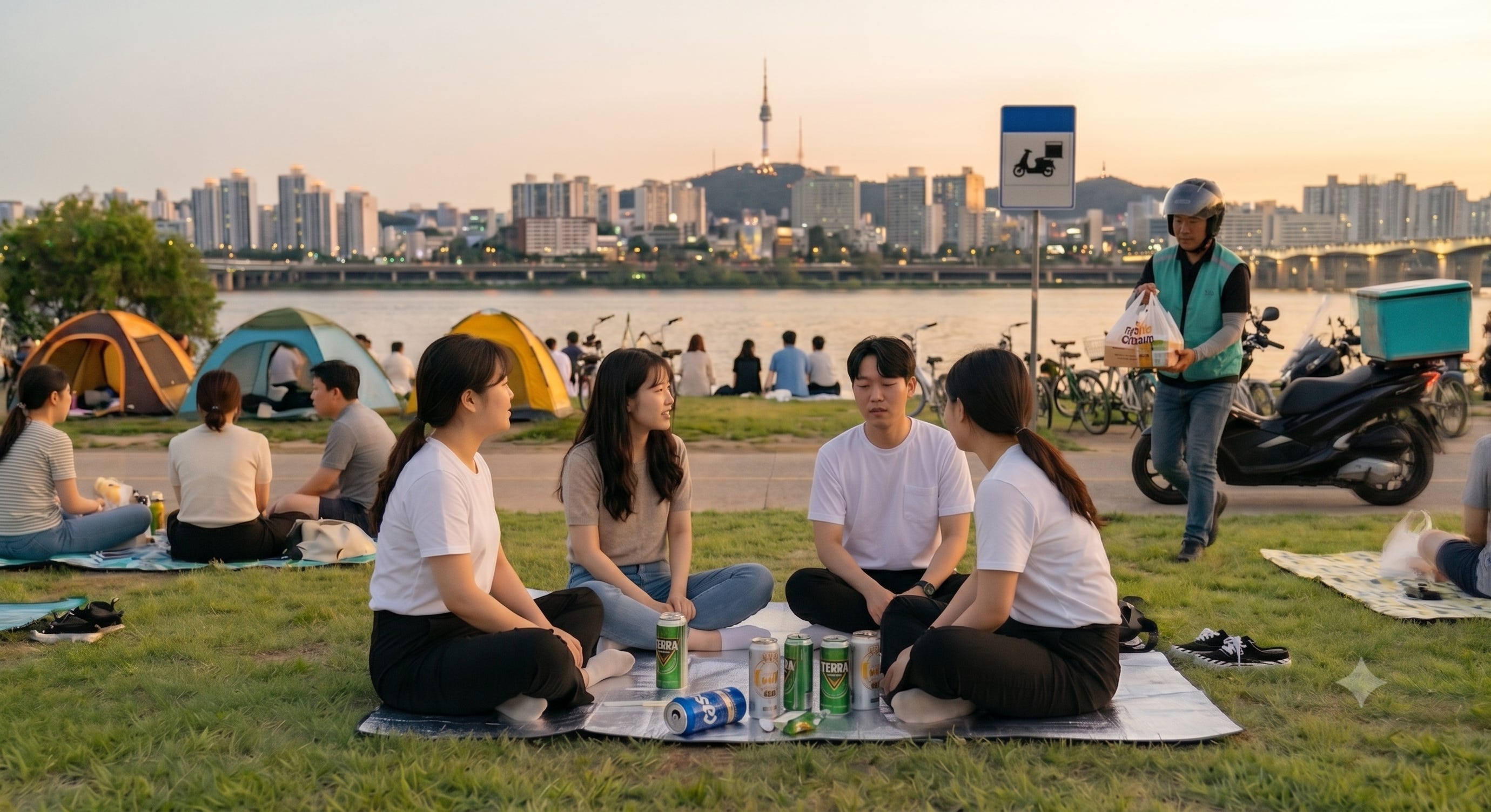
The grass is covered in plastic mats and picnic blankets. People are everywhere: couples taking photos of the skyline, families with small children who are somehow still awake, and friends passing around cans of beer and bags of chips from the convenience store. There is instant ramyeon steaming in paper cups. There are fried snacks in little plastic trays. And somewhere in this crowd, a group of friends is having what appears to be a very serious debate.
They are deciding what to order.
Not what to cook. Not which restaurant to walk to.
What to order, because dinner is going to find them here, on the grass, not at a private home but in the middle of a public park.
Someone opens an app. They drop a pin on the map and add a note: near the blue tent, by the rental bike station. About forty minutes later, a delivery rider pulls up to the designated zone, calls the number on the order, and walks a box of fried chicken through the crowd until it finds its rightful picnic blanket.
In many countries, food delivery requires an address. A doorbell. A house on a clearly labeled street.
In Korea, sometimes all you need is a park, a phone, and the quiet confidence that someone on a motorcycle will find you.
People who visit Korea often remark on how fast everything is: the internet, the public transit, the fashion cycles. And yes, delivery is fast too. But what genuinely surprises many foreign visitors is not only the speed. It is the sense that food can come to almost anywhere you happen to be. Parks. Beaches. Campus lawns. The parking lot where you are waiting for a friend. The car you are sitting in because you could not be bothered to go upstairs yet.
That is what this piece is about: not just how fast Korean delivery is, but how it became the kind of infrastructure that quietly makes modern life, and especially modern solitary life, possible.
Before the App: Cold Noodles and Dawn Soup
When we talk about food delivery today, we tend to think about technology: the app, the map, and the little animated rider inching toward your home. But the desire to have prepared food brought into your own space is considerably older than any smartphone.
In the late eighteenth century, a Korean scholar named Hwang Yunseok (황윤석) kept a meticulous diary of his life. In an entry from 1768, he notes that after taking the state civil service examination, he and his companions ordered naengmyeon (cold buckwheat noodles) straight to their quarters.
We do not know the full logistics of that transaction. There was no GPS, no estimated arrival time, and no option to leave a five-star rating for the courier’s “friendliness.”
What we have are records suggesting that people arranged for food to be brought from a vendor to wherever they already were. This does not mean modern app delivery existed in Joseon. But it does suggest something older: the desire to bring restaurant-quality food into one’s own social space, rather than always going to where the food is.
Another often-cited example is hyojonggaeng (효종갱), a rich, restorative soup whose name means something like “soup eaten when the dawn bell rings.” It was reportedly cooked at night just outside the city walls near Namhansanseong (남한산성), on the outskirts of Seoul. To make sure high-ranking officials inside the city received their soup still hot by the 4:00 a.m. curfew bell, couriers loaded the soup into heavy clay jars and wrapped them tightly in layers of cotton for insulation.
This short clip from YTN Science explains hyojonggaeng, the “dawn bell” soup that was delivered in Joseon times. Even if you don’t speak Korean, you can still see what the dish looked like and how couriers wrapped clay pots in layers of cotton to deliver hot soup before sunrise.
Before insulated delivery bags, there was cotton wrapped around a clay jar.
Long before any digital platform existed, people were already improvising ways to move hot food across cold distances, keeping it warm with whatever technology they had and navigating dark streets to deliver something comforting before the day began. The tools have changed beyond recognition. The impulse has not.
The Iron Box and the City That Ordered Together
For many Koreans, however, the emotional ancestor of modern food delivery is not an aristocracy’s dawn soup.
It is jjajangmyeon.
Jjajangmyeon is usually translated as “Korean-Chinese black bean noodles,” but that phrase needs a little unpacking. It is not quite Chinese food as people in China would expect it, and not simply Korean food either. It belongs to the world of Chinese restaurants in Korea, many of which were historically run by ethnic Chinese families who adapted Chinese dishes to Korean ingredients, Korean customers, and Korean city life.
This is why Koreans who travel to China and order what they think will be jjajangmyeon can be mildly heartbroken. The Chinese dish zhajiangmian is related, but it is not the same bowl Koreans grew up with: the glossy black sauce, the diced onions and pork, the yellow pickled radish on the side, and the delivery bowl arriving in a metal box. Jjajangmyeon is one of those foods that began as a migration story and became a national comfort food.
It is beloved by children, office workers, students, moving families, lonely people, hungry people, and people who were not hungry until someone said, “Should we order jjajangmyeon?”
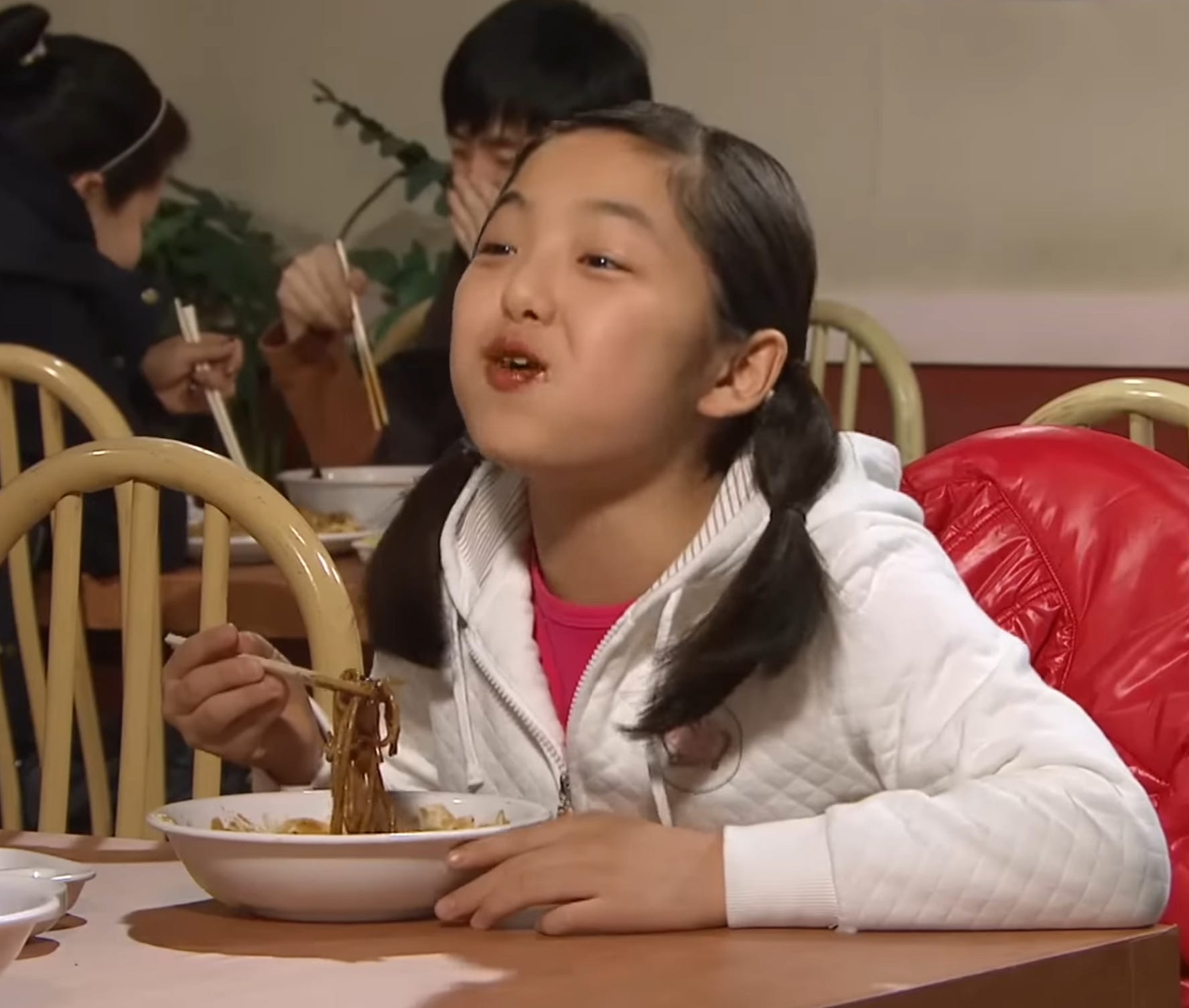
For much of the twentieth century, the image of food delivery in Korea was inseparable from the neighborhood Korean-Chinese restaurant and the delivery worker carrying a cheolgabang (철가방), literally an “iron bag,” though it was really a rectangular metal delivery box. Inside were bowls of jjajangmyeon, jjambbong (a spicy seafood noodle soup), and maybe tangsuyuk (sweet-and-sour pork), if the occasion had become serious.
This was the era of the phone order.
This clip is from a 2002 Korean news segment, and you don’t need to understand Korean to get it: you’ll see people ordering jjajangmyeon from mountains, university lawns, train stations, even the airport—and you’ll get a clear look at the old-school cheolgabang metal delivery box in action.
Before apps, there were paper menus stuck to refrigerators, flyers tucked into apartment doors, and neighborhood restaurants that knew the geography of everyday life: the apartment complex, the school, the office building, the factory gate, and the alley behind the stationery store.
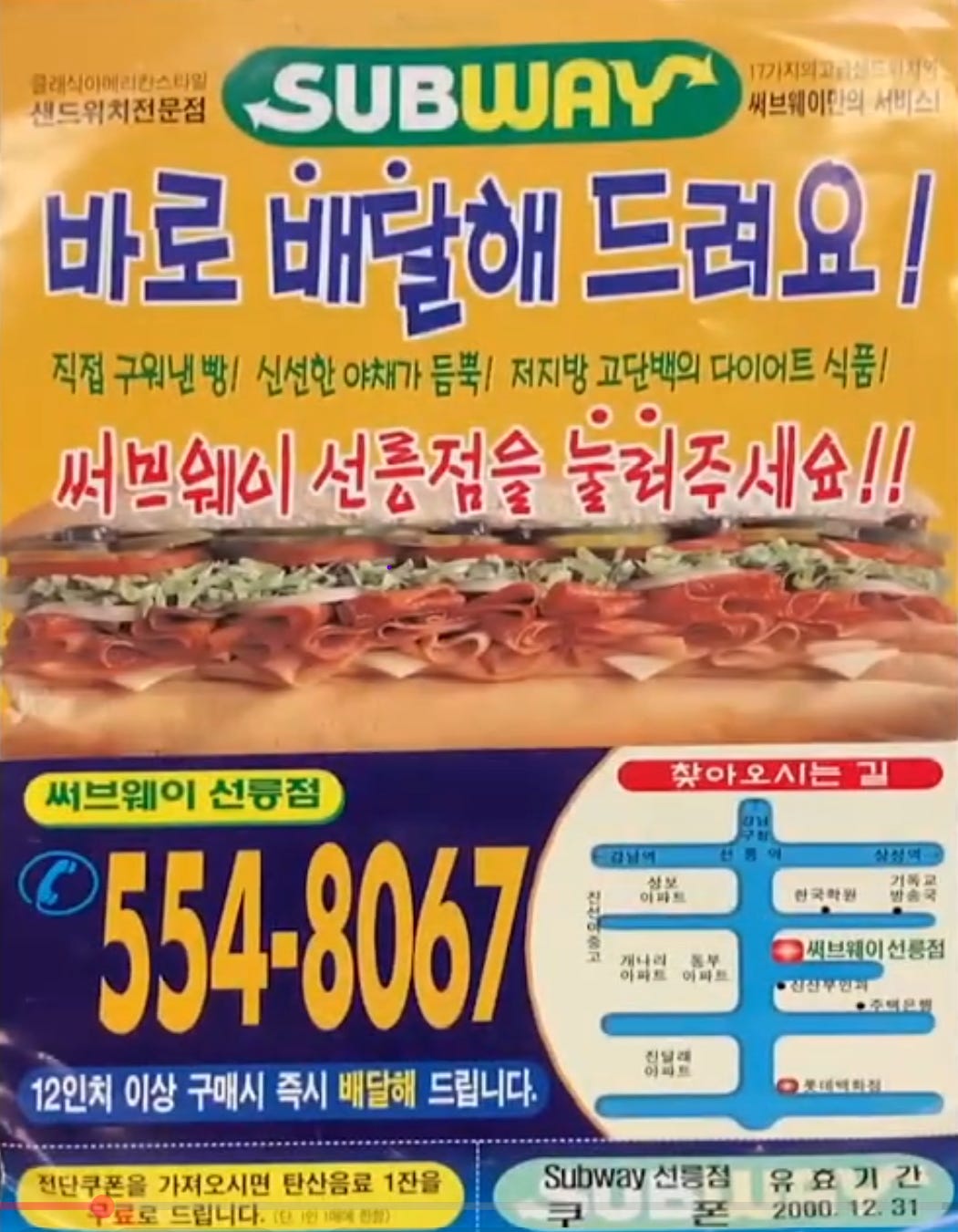
Food came by bicycle, then by motorcycle. The delivery worker arrived with the metal box, opened it, and the smell of black bean sauce announced that civilization had survived another day.
Before delivery became the companion of solitary eating, it was often the food of groups. It fed families moving into a new apartment, office workers staying late, students studying for exams, and children waiting for a weekend treat.
There is a reason Koreans associate moving day with jjajangmyeon. When a family moves, the kitchen is not ready. The pots are packed. The rice cooker is hiding in a box labeled “miscellaneous,” which is the graveyard of household order. Everyone is tired, dusty, and slightly irritable. Then jjajangmyeon arrives.
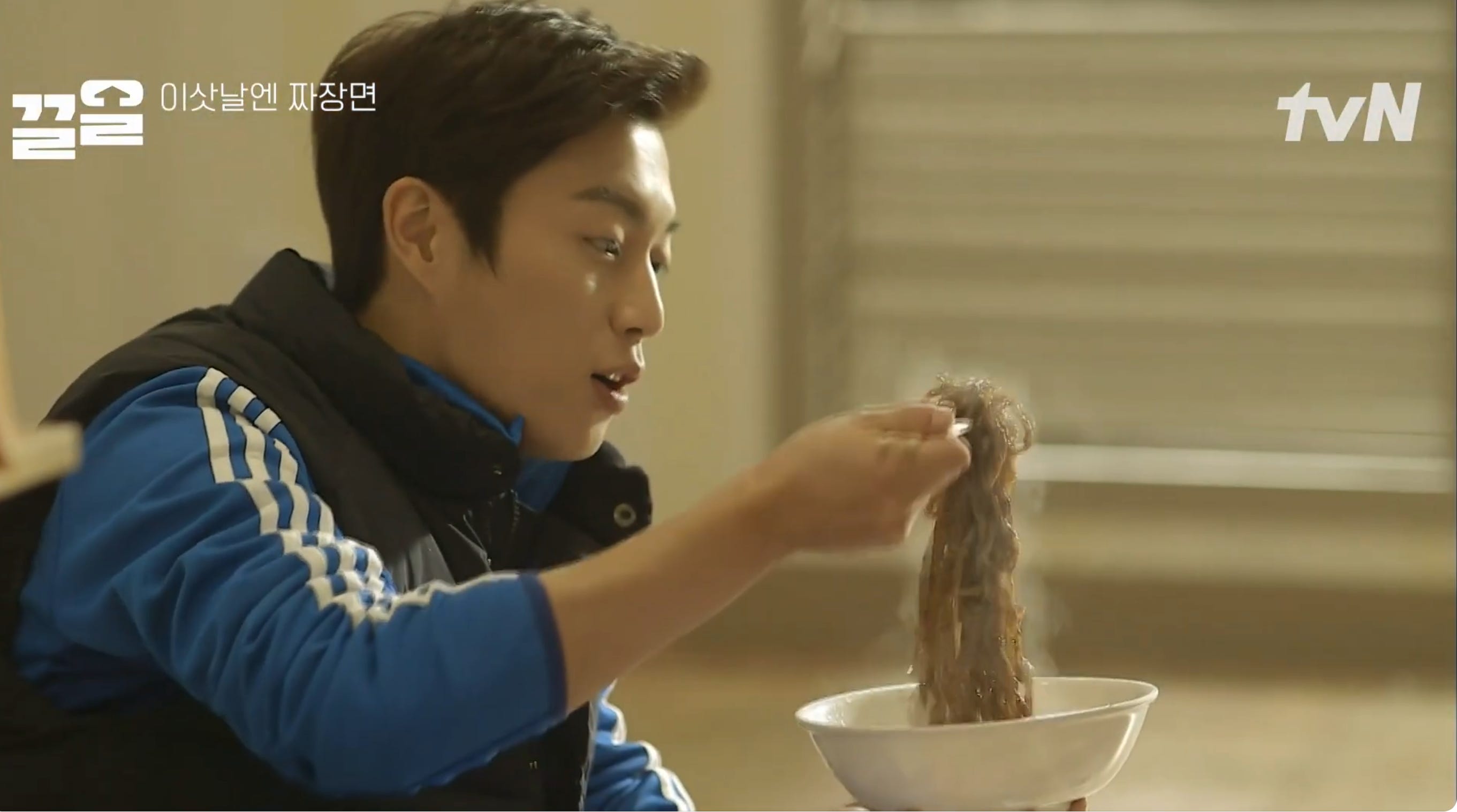
You sit on the floor, maybe on old newspapers or flattened cardboard, surrounded by boxes. You eat noodles from a delivered bowl. Nothing is in its proper place yet, but lunch has found you.
That, too, is infrastructure.
Delivery fed the modern Korean city not only because people ate alone, but because people were busy together. Families moved. Students studied late. Office workers worked later. Factories ran. Apartments rose. Neighborhood restaurants competed. The city learned to order.
When the Bowl Used to Come Back
There is another detail from the old delivery culture that matters, especially now.
The bowls came back.
In the older Chinese restaurant delivery system, the food arrived in reusable bowls. After eating, customers placed the empty dishes outside the door. Later, someone from the restaurant came back to collect them. This might sound inconvenient now, especially to anyone trained by the modern gospel of “leave at door.” But it created a kind of circular relationship.
The old iron delivery box did not just carry food. It carried a relationship.
The restaurant knew where the bowl had gone. The customer knew the bowl had to come back.
In the platform era, that relationship became thinner. The food still arrives hot, but the container often has nowhere to return.
The shift from restaurant-based delivery to platform-based delivery changed more than ordering. It changed the material life of the meal. Reusable bowls gave way to plastic containers, sealed lids, vinyl bags, sauce cups, disposable chopsticks, wet wipes, stickers, and packaging sturdy enough to survive a motorcycle ride, an elevator, a doorstep, and a photo review.
Convenience did not eliminate cleanup. It relocated it.
Instead of returning the bowl, the household now receives the meal and the waste that made the meal movable.
This is not only a Korean problem, of course. Platform delivery around the world has created mountains of packaging. But the contrast in Korea is especially striking because the older returnable-bowl culture is still within living memory. The change is not from “no delivery” to “delivery.” It is from one ecology of delivery to another.
The food kept moving. The bowl stopped coming home.
News clip about reusable stainless-steel containers for Han River food delivery.
Delivery is part of the fun of going to the Han River, but it also creates a lot of disposable waste. This report shows a newer system where people can order food in reusable containers and return them at designated stations in the park.
A modern echo of the old delivery bowl: the food comes to you, but the container does not have to become trash.
Why Korea? The Infrastructure Behind the App
Of course, Korea is not the only country where food can find you in unexpected places.
Two years ago, my family gathered in Pattaya, Thailand. My younger brother was living in Thailand at the time, and one day we were all at the beach together. As often happens with families, everyone wanted something slightly different. Someone wanted Thai food. Someone wanted Korean food. Someone wanted something cold. Someone wanted something spicy. So we did what people now do in many parts of Asia: we ordered several different things and let dinner come to us by the water.
Not a restaurant table. Not a hotel lobby. The beach.
Someone had ordered, someone had navigated, and dinner had crossed the soft boundary between city and sea.
Later, I mentioned that I missed moo ping, the Thai grilled pork skewers I used to eat when I lived in Thailand as a teenager. My brother immediately ordered some to our hotel. When I said it was unbelievably good, he told me he could have ordered from a closer place nearby, but he had chosen a famous shop instead, the kind of place known not only for its pork skewers but for its sauce, the kind of sauce so famous that people still whisper, half-joking and half-serious, that it bought the owner a building.
This is to say: Korea does not have an exclusive patent on flexible food delivery. Thailand has its own version. China has its own version. Singapore has its own version. Americans have DoorDash and Uber Eats. London has Deliveroo. In large cities and dense tourist areas around the world, dinner can now travel through an app.
The question, then, is not whether Korea has delivery and other countries do not.
The question is what Korean delivery culture reveals when we look at it closely.
When I visited Korea, I went over to two different friends’ apartments in Seoul. Both friends were busy in the way everyone in Seoul seems to be busy, with lives already packed to the edges. They had not spent the afternoon cooking. Instead, almost naturally, they handed me the delivery app and said, “You’re pregnant. You choose what you want to eat.”
That was the moment I understood something. In Korea, delivery did not feel like the absence of care. It felt like one of the ways care had adapted to a city where everyone was exhausted, hurried, and still expected to feed one another.
Consider what was already in place before the first major delivery apps launched around 2010. Korea already had dense urban geographies, not just dense by American suburban standards, but dense in a way that makes food delivery unusually efficient. More than half of South Korea’s population now lives in the capital area, and more than half of households live in apartments. One-person households have also become the most common household type.
Those numbers are not just demographic trivia. They describe the physical and social conditions that make delivery both efficient and desirable: many people living close together, often stacked vertically in apartment complexes, often eating in smaller household units.
A rider can deliver many orders across a dense neighborhood. A restaurant can reach customers beyond its immediate street. A person living alone can order one meal without buying ingredients for five. An apartment door becomes a private dining room. A lobby becomes a logistics point. An elevator becomes part of the food system.
Korea also had a culture of restaurants competing intensely on delivery-friendliness. Fried chicken, Korean-Chinese food, jokbal (braised pork trotters), tteokbokki (spicy rice cakes), soups, stews, and rice dishes: much of what Koreans already loved to eat was inherently packable, portable, and best served hot. In other words, the menu was already optimized for travel.
Then add the older layers: neighborhood restaurants, phone orders, flyers tucked into apartment doors, menus taped to refrigerators, motorcycles that could slip through narrow streets, and a culture already accustomed to calling for dinner.
Then add smartphones and GPS.
The result is not merely faster delivery. It is a country that becomes, in a very literal sense, more deliverable.
This is also why global platforms have struggled to crack the Korean market.
Uber Eats entered South Korea with the same playbook that had worked elsewhere—and exited the market in 2019, just two years after launching, quietly and without much fanfare. The contrast with Japan is striking: Uber Eats became one of the dominant food delivery apps there, in a country it entered around the same time.
But Korea was a different story entirely. The Korean delivery ecosystem had not been waiting for rescue.
What works in the sprawling suburbs of the United States does not automatically translate to a country of apartment towers, narrow alleyways, and twenty-minute expectations.
This is why Korean delivery can feel different from American delivery, even when the basic action looks similar. In the United States, delivery often depends on cars, longer distances, tipping norms, suburban spread, and platforms that can feel like expensive intermediaries between you and a restaurant. Ordering delivery can come with a small arithmetic headache: the base price, the delivery fee, the service fee, the suggested tip, the "optional" extra tip for the courier.
Korea has its own pricing problems, especially now, and I will come back to those in the next essays. But culturally, the transaction has long felt different. The delivery fee is understood as the delivery fee. You pay it; the food comes. No one is doing moral calculus over whether 18 percent makes you a decent person or a villain.
The genius of Korean delivery is not only speed. It is density: dense cities, dense apartment living, dense restaurant competition, and dense social expectations about how quickly things should arrive.
When apps came along, they did not build this culture from nothing. They accelerated it.
By March 2026, the combined estimated payment value across Korea’s four major delivery platforms exceeded 3 trillion won in a single month, roughly 2.1 billion U.S. dollars, and had grown every year since 2023. This is not a pandemic habit that faded when people went back outside. It is an infrastructure that expanded and stayed.
The Meal No One Has to See
This is where delivery meets honbap.
Honbap, eating alone, has changed enormously in Korea. As I wrote in the previous essay, eating alone used to carry more social discomfort. A person sitting alone in a restaurant could feel exposed. The table made solitude visible.
Delivery changed the visibility of eating alone.
If eating alone in a restaurant made solitude public, delivery made it private.
You did not have to walk into a restaurant alone. You did not have to ask for a table for one. You did not have to sit under fluorescent lights, aware of other people’s eyes. You could close the door, open an app, and eat in peace.
This is one reason delivery became such an important infrastructure for honbap. It did not simply feed people who lived alone. It removed the social stage on which eating alone had once been performed.
At home, there is no need to justify the meal.
You can eat tteokbokki for dinner. You can order porridge because you feel sick. You can get fried chicken because the day was too long. You can order a single-serving rice bowl and watch a drama. You can eat slowly, badly, happily, silently, in pajamas, while standing in the kitchen, or while pretending that watching YouTube counts as companionship.
Delivery makes fewer demands than a restaurant.
But it does not leave you entirely alone.
The app recommends. The reviews persuade. The ratings sort. The coupons nudge. Your previous orders become data. Your hunger becomes a pattern. Even the private meal is quietly organized by a public platform.
This is the strange intimacy of modern delivery. It removes the gaze of the restaurant, but introduces the gaze of the system.
Earlier, I wrote about mukbang, the broadcast of eating. Mukbang turns eating into a spectacle. It makes the meal visible, audible, shared, exaggerated. Delivery does almost the opposite. It helps eating disappear into the room.
Mukbang is visible honbap.
Delivery is invisible honbap.
And together, they tell us something about contemporary Korean life: even solitude needs infrastructure.
The Miracle and Its Cost
And yet, every infrastructure has a shadow.
Food does not arrive by magic.
Someone rides through rain. Someone waits at a traffic light. Someone carries the soup. Someone pays the commission. Someone worries about the review. Someone absorbs the cost of “free” delivery. Someone cleans, packs, seals, and hopes the jjigae does not spill before it reaches the thirteenth floor.
This essay has stayed mostly on the consumer’s side of the door: the park bench, the pregnant guest, the moving-day family, and the person eating alone at home. But the next part of the story has to cross that threshold.
Because the more ordinary the miracle becomes, the easier it is to stop seeing the people who make it ordinary.
South Korea built a culture in which dinner can find you almost anywhere.
The harder question is what happens to the people who make that feel normal.
Next week, I want to cross that threshold with two books by Park Jung-hoon: Baedal Minjok Does Not Deliver (배달의민족은 배달하지 않는다) and Platforms Do Not Deliver Safety (플랫폼은 안전을 배달하지 않는다).
The titles are almost built as warnings. A company named “the people of delivery” does not deliver. A platform that delivers food does not deliver safety. What, then, is actually being delivered? And what is being quietly handed off to someone else?
Together, these books ask us to look beyond the warm container at the door and into the system that brought it there: the labor, speed, danger, responsibility, and cost hidden inside a meal that arrives too easily.
The jjajangmyeon moving day detail is so specifically Korean and yet I immediately recognized the equivalent — in Taiwan it's lu rou fan or beef noodle soup arriving in the chaos of an unpacked kitchen. The food that finds you when your home isn't ready yet is its own category of comfort that has nothing to do with convenience and everything to do with the feeling that someone still fed you today.
Wow, lots of history here too. Hyojonggaeng ... one of the first videos, I think. Boiling food directly to the table. Sign me up! Wonderful post, again.