

This is Part 21 of the series The People’s Mandate: Korea’s Democratic Edge, a special miniseries within Growing Up in Korea (Part 31).
Last week, we explored how the Korean War created a survival algorithm that would govern Korean society for decades. This week, we dive deeper into how that algorithm became a prison.
It’s a bitterly cold night in Seoul, January 1968.
The war was supposed to be over, a ghost haunting grainy photographs. But suddenly, the ghost is at the door.
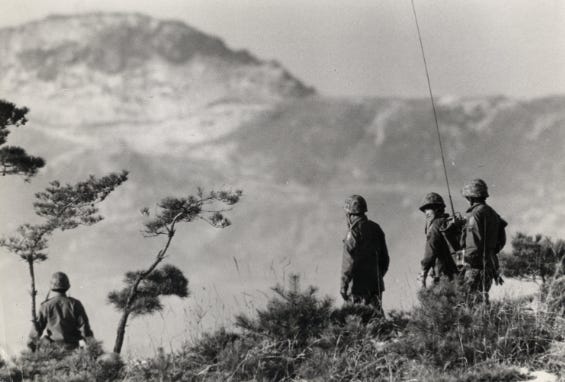
A team of 31 North Korean commandos, elite and deadly, has slipped through the world’s most heavily fortified border. Their mission? To slice off the head of South Korea’s military dictator, Park Chung-hee. They get within a few hundred meters of the Blue House, the presidential palace, before a gunfight erupts in the streets.
The commandos are killed or captured, but the mission succeeds in one terrifying way: it reminds everyone that the war never truly ended. The temporary state of emergency, the feeling of sleeping with one eye open, was about to become the permanent operating system for an entire nation.
The South Korean government built a prison from that fear. Not a prison of steel bars, but one with brick walls made of memory, laws made of trauma, and a pervasive, chilling silence.
The ghost of the Korean War was weaponized, turning the abstract threat of “North Korea” into a tool to control a nation, erase inconvenient histories, and define what it meant to be Korean.
Korea’s war trauma didn’t simply echo. It was curated. Anti-communism and the very real threat from the North legitimized a ‘garrison-state’ mindset: the logic that a nation under constant threat must operate like a military fortress, where security trumps all other values like freedom and human rights. This logic seeped into laws, schools, newsrooms, and living rooms.
In the process, memories that contradicted the official story (massacres, blame, inconvenient grief) were pushed offstage. And yet, from campuses and city squares, people fought to reclaim two basic democratic rights: to speak and to remember.
The Mirror of Division: North Korea as a Constant Companion
To outsiders, North Korea is often just “the crazy neighbor with strange haircuts and too many statues.” Inside Korea, it’s far trickier.
Imagine having a twin brother who, after a catastrophic family feud, is now your sworn enemy. He wants to burn your house down. But also, he’s still your brother. You have the same memories, the same face. You define yourself by how you are not him.
This is the “Mirror of Division.”
For decades, North Korea wasn’t just an enemy; it was a paradoxical obsession. It was both the “lost half of the nation we must reclaim” and the “godless communist antithesis to our freedom-loving society.” This created a permanent, low-grade national anxiety that was incredibly useful for those in power.
The logic was simple and brutal: your enemy’s threat justifies your own control. This created what scholars call “antagonistic co-dependency.”
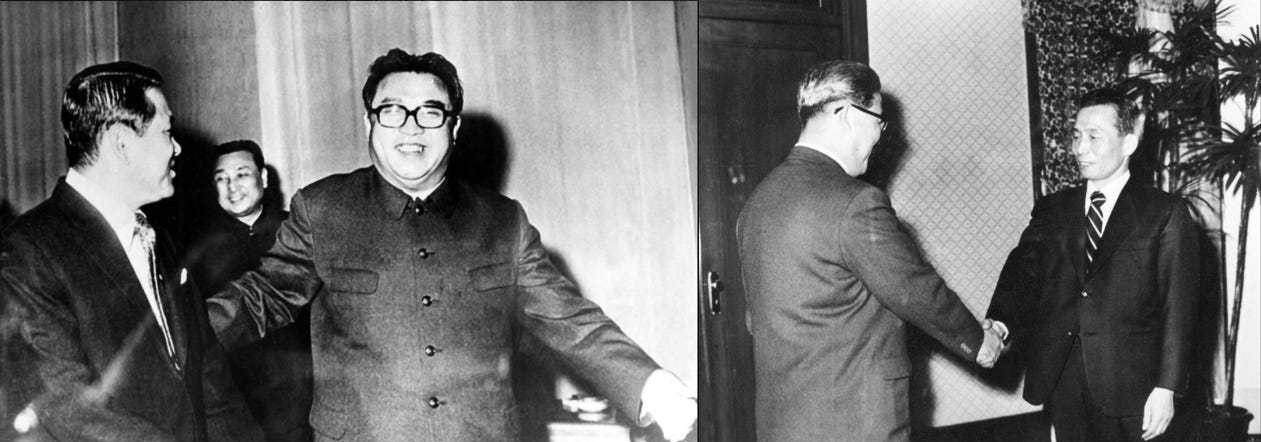
The dictators in both the North and South, while pointing missiles at each other, were in a strange sort of partnership. Kim Il-sung’s military provocations gave Park Chung-hee the perfect excuse to crush student protests, rig elections, and declare that democracy was a luxury the nation couldn’t afford. In turn, Park’s iron-fisted rule proved Pyongyang’s propaganda that the South was a puppet state of American imperialists. They were each other’s best boogeymen.
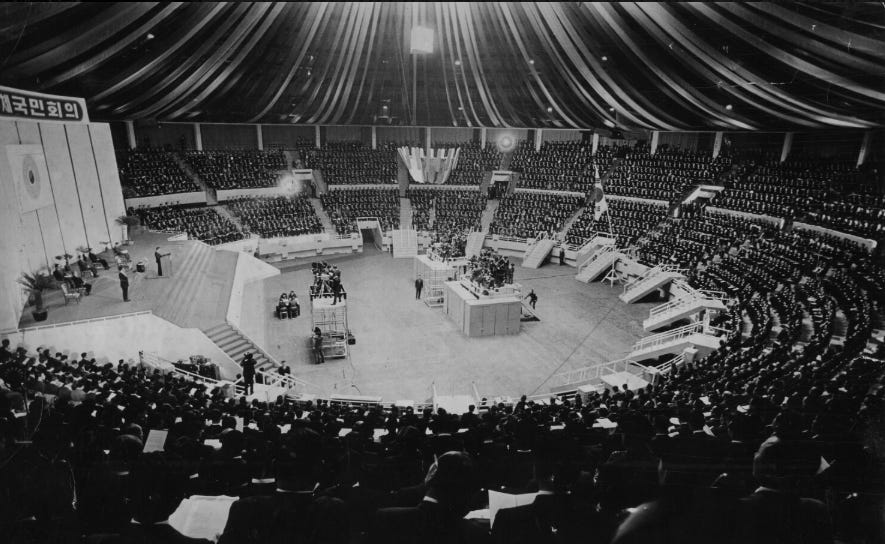
The most cynical example of this was the July 4th Joint Communiqué in 1972 (7·4 남북 공동 성명). On the surface, it was a breakthrough (a joint promise to pursue peaceful reunification). The world applauded. But it was a smokescreen. Back home, both leaders used the ‘grave new reality of dialogue’ as a pretext to grant themselves absolute power. Park declared the Yushin Constitution (a new political system ironically named ‘revitalization’) which effectively entrenched his rule through indefinite terms and indirect election by a handpicked electoral college. Meanwhile, Kim consolidated his own eternal rule. They used the language of peace to build their own prisons.
This wasn’t like the Cold War in America or Germany. For South Koreans, the enemy wasn’t an abstract ideology across an ocean; it was a literal presence just 35 miles from Seoul. The border didn’t just divide a country; it ran through families, friendships, and the national soul. And the state was about to make sure that border ran through every single home.
Voices from the Silence: How Literature Became a Witness
In a society where historical truth and personal pain were forced into silence, novelists became the nation’s conscience. While official narratives spoke of anti-communist heroes, writers dared to tell the stories of those crushed between the gears of ideology. They gave voice to the ghosts who were never properly mourned. Though many of these works, like Han Kang’s 2024 Nobel Prize-winning Human Acts (소년이 온다), are now gaining international acclaim, they are part of a rich and courageous literary tradition that fought for the right to remember.
Here are a few glimpses into that world.
The Lifelong Shadow of a Label: A Father’s Liberation Diary (아버지의 해방일지) by Jeong Ji-a
Jeong Ji-a’s deeply personal novel tells the story of her own father, a former partisan guerrilla in the mountains. In her own words:
“Father lived as a partisan from the winter of 1948 to the spring of 1952. It dominated his entire life, but he was actually a partisan for only four years. Those four years strangled his whole life, not because his beliefs were so strong, but because South Korean society forbade socialism and made it impossible for anyone who had once been a socialist to ever return to normal society.”
The novel reveals the brutal reality of yeonjwaje (연좌제), or guilt by association. Because of an uncle who had been a partisan, the protagonist’s family member couldn’t attend military academy despite passing the exam. Her fiancé, knowing her family background, chose to become a lawyer rather than a judge or prosecutor (professions that required “ideological purity”). Eventually, the engagement was broken.
A few years of different choices didn’t just destroy one person’s life. It buried entire families.
When Your Parents’ Past Becomes Your Prison: Daughter of a Partisan (빨치산의 딸) by Jeong Ji-a
Before A Father’s Liberation Diary, Jeong published Daughter of a Partisan (1990), a book that itself became evidence: seized, questioned, surveilled.
This “documentary novel” reconstructs her parents’ lives as members of the South Korean Workers’ Party (남로당) who fought as partisans from 1947 onward.
But the novel isn’t just about the war years. It’s about what came after. Her parents survived the mountains, only to spend the rest of their lives as non-persons in their own country. Their only daughter, the author, grew up as “Red offspring” (ppalgaengi jaesik, 빨갱이 자식), a label that followed her to school, to job interviews, to marriage prospects.
The book shows how Korea’s “security state” didn’t end with the 1953 armistice. It intensified. Through the 1960s, 70s, and 80s, the National Security Law became a tool to crush not just communists, but anyone inconvenient: students, writers, union organizers, and their families.
As literary critic Kim Hyung-soo noted: “This novel reminds us that today’s agonizing past continues to shape who we are.” The partisans’ dreams were betrayed, but their children (like Jeong Ji-a) carry their memory forward, refusing to let history be erased.
Love Under Surveillance: The Old Garden (오래된 정원) by Hwang Sok-yong
[Available in English translation]
Hwang Sok-yong’s The Old Garden is set in the 1970s-1980s, during South Korea’s darkest years of military dictatorship. The protagonist, Oh Hyun-woo, is a democracy activist arrested for opposing the regime. He spends 18 years in prison, not for violence, not for espionage, but for demanding basic freedoms.
While he’s locked away, his lover Han Yoon-hee waits alone, under constant state surveillance. The novel captures how “security logic” didn’t just imprison dissidents; it turned lovers into suspects, homes into interrogation sites, and entire communities into informants.
One of the most haunting aspects is how ordinary life became impossible for anyone labeled “impure.” Yoon-hee can’t hold certain jobs. She’s followed. Her mail is opened. Her friends are questioned. The state doesn’t just punish activists. It suffocates everyone around them.
Hwang Sok-yong himself knew this intimately. In 1989, he illegally visited North Korea to attend a literary conference, seeking dialogue and reconciliation. Upon return in 1993, he was arrested under the National Security Law and sentenced to prison. His crime? Talking to other Koreans. The novel he wrote after release (The Old Garden) is both a love story and an indictment of a state that criminalized hope.

More Voices from the Darkness
The literary resistance didn’t stop there. Here are a few more works that bore witness:
Choi In-hun, The Square (광장, 1960)
[Available in English translation]
Written just after the Korean War, this novel follows a South Korean intellectual who goes North and becomes disillusioned with both systems. The protagonist, Yi Myeong-jun, chooses neither. He demands to go to a neutral country during prisoner exchanges. The novel asks: What if there’s no safe ideological “home”? In a divided Korea obsessed with loyalty tests, The Square was revolutionary for refusing to pick a side.

Cho Se-hui, The Dwarf (난쟁이가 쏘아올린 작은 공, 1978)
[Available in English translation]
This linked-story novel captures the brutality of Korea’s industrialization under dictatorship. A family of factory workers is crushed, not by North Korean spies, but by their own government’s economic policies. The father, a dwarf, asks heartbreaking questions: “Is my child really my child? Or is he a machine part?” The novel exposes how “anti-communism” was weaponized not just against leftists, but against workers demanding dignity.

Yi Mun-yol, Our Twisted Hero (우리들의 일그러진 영웅, 1987)
[Available in English translation]
A deceptively simple story about an elementary school classroom where a bully rules through fear and complicity. But the novel is an allegory: the classroom is Korea, and the bully is dictatorship. Published during the pro-democracy uprising of 1987, it asks: How do ordinary people become complicit in their own oppression? And more painfully: What does it cost to finally say “no”?

Im Chul-woo, Spring Day (봄날, 1997)
Set during the 1980 Gwangju Uprising, this five-volume epic novel reconstructs ten days that shook Korea. Through multiple perspectives (including ordinary citizens, students, and even soldiers), Im depicts the brutal state violence and the citizens’ extraordinary courage. The novel follows the Han family’s three sons caught in different positions during the massacre, showing how the “security state” didn’t need actual enemies. Suspicion itself was the weapon, and resistance became an act of survival.
What These Novels Tell Us
Across decades and genres, these works share common threads:
Security as Control: “National security” wasn’t about protecting citizens. It was about controlling them.
Guilt by Blood: Your parents’ choices (or even your uncle’s) could destroy your entire life, decades later.
Surveillance as Daily Life: The state didn’t just watch dissidents; it watched their lovers, their children, their neighbors.
The Impossibility of Normal: To be labeled “impure” meant permanent exile, not from the country, but from ordinary life itself.
Memory as Resistance: Writers risked everything to ensure these stories weren’t forgotten.
These aren’t distant historical curiosities. Many of the people who lived through this are still alive. And the National Security Law? Still on the books.
Korea, despite enduring such dictators, has become a nation with the strength to hold its leaders accountable, even removing presidents who fail to serve the people. This resilience owes much to the writers, students, and ordinary citizens who risked everything to preserve these memories and fight for the right to speak truth. Their courage loosened the bars of an invisible prison.
Next Week: A Special Announcement
The next part of this story should explore how “anti-communism” became national doctrine and society was reorganized into one giant garrison. But before that, I have an announcement to make.
I’m making some changes to this newsletter, and I want to take time to explain them properly. That’s what next week will be about! Then, in the final week of October, something new will begin. (Every month’s last week brings something new around here.)
Stay tuned!
Until then, remember: The security prison was built not with walls, but with fear. And it was writers, students, and ordinary people who dared to remember differently that eventually broke it open.


