
60. The Business of Hunger: When Comfort Becomes Content
What happened when mukbang stopped being only a shared table and became an industry of appetite, trust, labor, and profit.

🎧 Companion Podcast: Same Table, Different Dish
While this essay focuses on the market and the scandals, the podcast goes into a “Professor Yoon” deep dive: grounded cognition (why your brain can taste the screen), Bee Wilson’s “Global Standard Eater,” a quick breakdown of the “taste algorithm,” and a practical media-literacy checklist you can actually use.
Last week, I wrote about mukbang in its gentlest form: the screen-table as a substitute for company.
One person eats alone. Another person turns on a video. And between them, something that resembles company appears.
That was the gentle version of mukbang.
This week, we need to talk about what happened next.
Because at some point between 2010 and now, something shifted. The lonely person at the table was still there. The creator was still eating. But between them, something new had entered the room.
A camera crew.
A sponsored product.
A contract.
A comment section doing quality control.
Loneliness became watch time.
Watch time became advertising revenue.
And someone’s appetite became both performance and labor.
This is the part of the mukbang story that feels less comfortable but matters just as much. Because mukbang is not just a cultural phenomenon. It is also, by any reasonable measure, one of the more revealing mirrors that contemporary Korea has held up to itself.
So let’s look at what it shows.
From Star Balloons to Shopping Carts
To understand how mukbang became a business, it helps to trace the money.
The original mukbang economy was built on intimacy. On AfreecaTV, viewers could send creators paid digital gifts called byeolpungseon (별풍선), or “star balloons,” which could be converted into real income. The system was elegant in its logic: you supported someone whose company you enjoyed, the way you might buy a friend dinner. Except the “friend” had thousands of people sending star balloons at once.

This was not yet an industry. It was more like a tip jar at a very popular kitchen table.
Then came YouTube, and everything scaled up.
The revenue structure expanded from star balloons to YouTube ads, sponsorships, affiliate links, product placements, brand deals, restaurant promotions, and live commerce. A creator could eat a product, praise a product, sell a product, and help move an astonishing amount of food through one video.
This is the general logic of the creator economy. But mukbang makes that logic unusually visible because the “content” is literally entering the creator’s body.
South Korea’s creator-media industry has grown rapidly. A 2024 report on government survey data stated that the domestic digital creator media industry recorded 5.3159 trillion won, roughly $3.5 billion, in revenue in 2023, up 28.9 percent from the previous year. The same survey found 42,378 workers in the sector, while also showing how small-scale the ecosystem remains: 83.5 percent of creator-media businesses had fewer than five employees.
That contrast matters. From the outside, the creator economy can look glamorous: bright lights, huge meals, millions of subscribers, comments from around the world. But structurally, much of it is small, fragile, and highly unequal.
The top looks very different from the bottom.
According to 2024 income data, the top 1 percent of South Korean YouTubers, 348 creators, earned a combined 450.1 billion won, roughly $298 million. That averages about 1.29 billion won, or about $853,000, per creator.
That is a stunning number. It is also a misleading fantasy if read as the normal creator experience. Most creators are nowhere near that level. Many are small operations trying to survive in an algorithmic marketplace where attention is unstable, platforms change rules, and the body, the face, the voice, and sometimes the digestive system become part of the job.
The Body Behind the Feast
This is where mukbang becomes not just “watching someone eat,” but eating as labor.
And sometimes, very hard labor.
One of the first-generation Korean mukbang stars, Banzz (밴쯔), became famous not only for how much he ate, but also for the disciplined body that seemed to make it possible. In interviews, Banzz has said that he worked out for many hours a day to maintain his physique while eating large quantities on camera.
That detail changes the picture.

The cheerful screen says: Look how much he can eat.
The hidden routine says: Look how much work is required to make that eating acceptable.
A “body that can eat anything” may look effortless on camera. But often, it is built on exercise, food control, bodily discipline, and a kind of physical accounting that viewers rarely see.
Of course, not every mukbang body follows the same script.
Tzuyang (쯔양), one of Korea’s most recognizable mukbang YouTubers, complicates the usual story in almost comic-book fashion. She is famous not only for how much she eats, but for how little that eating seems to show on her body. According to her, she used to stay around 46 to 48 kilograms, about 101 to 106 pounds, gained up to about 58 kilograms, about 128 pounds, when she exercised, and then dropped back down after stopping exercise. In other words, while most of us exercise in the hope of managing what we ate, Tzuyang once described the opposite problem: exercise made her body bigger.
For viewers, this turns her into a kind of metabolic riddle.
Where does it all go?
Korean comment sections have built entire miniature philosophies around that question. There is a familiar joke that it is amazing such low-fuel-efficiency humans survived evolution at all: people who seem to eat and eat, only to send it right back out into the universe instead of storing it for famine like the rest of us tragically efficient mammals.
This is not a medical explanation. It is internet awe with chopsticks.
But the joke reveals something important. Whether the creator is Banzz, whose eating was framed through discipline and visible bodily work, or Tzuyang, whose eating seems to defy ordinary nutritional imagination, the body is never just the container for the meal.
In mukbang, the body becomes part of the spectacle.
Part of the mystery.
Part of the business model.
The fantasy is excess without consequence.
The labor, or at least the fascination, is consequence management.
The Scandal That Broke the Table
If mukbang depends on trust, then the 2020 dwit-gwanggo (뒷광고) scandal was a rupture at the center of the table.
Dwit-gwanggo literally means something like “back advertising.” In English, we might call it undisclosed advertising or hidden sponsorship. The problem was simple: influencers promoted products as if they were personal recommendations or self-purchased reviews, while failing to clearly disclose that they had been paid or sponsored.
This scandal did not only affect mukbang creators, but it hit them especially hard because food content depends so much on the viewer believing the eater.
If a creator says, “This is delicious,” the viewer wants to believe that the reaction is real. Not scripted. Not bought. Not performed only because a brand paid for the table.
Several major mukbang creators were implicated, including Moon Bokhi (문복희), known as Eat Boki (잇보키), one of Korea’s best-known eating YouTubers. The revelation was not just that creators had taken money. It was that some had taken money and then looked directly into the camera as though the recommendation were entirely spontaneous.
The apology itself drew nearly as much criticism as the original scandal. Moon Bokhi did not post an apology video, the format in which she had built her entire career and income. Instead, she posted a text statement in the YouTube Community tab. For many viewers, the asymmetry was impossible to ignore: the deception had happened on camera, where it reached millions. The apology happened in a text box, where fewer people would see it.
There was a further dimension that deserves attention, especially for international viewers. Moon Bokhi’s channel had a large global audience, and her comment sections often included many English-speaking fans. But her apology appeared as a Korean-language text post in the YouTube Community tab, not as a video and not, at least initially, as an English-language explanation for her international audience.
Some viewers read this absence not as a small oversight, but as another failure of transparency: Korean-speaking viewers could understand the controversy, while many international fans might simply move on, unaware of what had happened. Korean-speaking viewers then began translating the apology and explaining the controversy in English in the comments.
The episode showed how fragile trust had become in the globalized mukbang economy. The audience was no longer only Korean, but the accountability still moved unevenly across language lines.
The scandal eventually led South Korea’s Fair Trade Commission to strengthen disclosure expectations for influencer marketing, and legal commentary at the time emphasized the need for clear, platform-appropriate disclosure of paid endorsements.
What collapsed was not only legal compliance.
It was the emotional contract.
A mukbang creator is not exactly a restaurant critic, not exactly a friend, not exactly an entertainer, and not exactly a salesperson. That ambiguity is part of the appeal. The creator sits close to us, talks casually, eats with apparent sincerity, and makes the viewer feel included in a small private scene.
That intimacy is precisely why hidden sponsorship feels so violating.
If a television commercial is a commercial, we know what game we are playing. But if a creator appears to be sharing a personal craving, a favorite restaurant, or a spontaneous reaction, then undisclosed payment changes the meaning of the scene.
It turns appetite into advertising while pretending it is still appetite.
And here is where the research gets genuinely interesting.
A study by Ahn Suntae and colleagues found that when advertising disclosure is made clearly and prominently, 96.3 percent of viewers correctly identify the content as an advertisement.
That sounds like a win for transparency.
But the same research found something unexpected: for viewers who came to mukbang with instrumental motivations, seeking information, looking for recommendations, wanting to find out what a dish actually tastes like, being told that a video is an advertisement does not necessarily reduce their intention to eat the food. If anything, it can slightly increase it.
The lesson is clear: if you already trust the creator, knowing they were paid does not necessarily break the trust. It is the concealment that destroys it, not the relationship itself.
Transparency, in other words, is not an obstacle to commerce.
It is its precondition.
When “Real Eating” Becomes the Product
While the dwit-gwanggo scandal broke trust through deception, another controversy struck at something even more fundamental: the question of whether the eating itself was real.
Meokbaet (먹뱉), a portmanteau of meokda (먹다), “to eat,” and baetda (뱉다), “to spit,” refers to the alleged practice of chewing food and spitting it out before swallowing, then using editing to remove evidence from the final video. Some viewers and online investigators claimed that certain creators’ apparent abilities to consume enormous quantities without visible physical consequence were simply not biologically plausible.
Several creators responded by releasing unedited footage or switching to live broadcasts, precisely to demonstrate that the eating was genuine.
What the meokbaet controversy reveals, beneath its somewhat absurd surface, is that authenticity is the genre’s most valuable asset.
A mukbang video is, in a sense, a promise. The promise is: this person is really eating this, really reacting to it, really there. Break that promise and the entire structure of vicarious satisfaction, the borrowed appetite, the borrowed company, collapses.
The viewer can tolerate knowing that a creator was paid. They can tolerate knowing the creator exercises for hours a day. What they cannot tolerate, apparently, is finding out that the eating itself was simulated.
Because that is the one thing they came for.
When Watching Makes You Hungry, Or Not
Health research on mukbang is complicated and rarely points to a single conclusion.
For some viewers, mukbang can offer comfort, appetite stimulation, or even a way to approach food when eating feels difficult. A 2025 scoping review on the use of mukbang in health promotion found that the genre has been discussed not only in terms of risk, but also in terms of possible functions such as vicarious satiation, appetite stimulation, and digital companionship.
For others, especially viewers already struggling with binge eating, body dissatisfaction, or impulse control, mukbang may work very differently.
A 2020 netnographic study explored how viewers related mukbang watching to symptoms of disordered eating. Some viewers described using mukbang as a substitute for eating or as a way to manage cravings, while others connected it to difficult eating patterns.
This is important because people often want a simple, binary moral answer.
Is mukbang good or bad?
That question is too flat.
A better question is: For whom, in what context, with what kind of content, and in what emotional state?
A person trying to rebuild a less anxious relationship with food may experience watching someone eat as reassuring.
A person prone to binge eating may experience the same video as a trigger.
A lonely person may feel comforted.
A dieting person may feel tortured.
A curious viewer may use the video as information.
A tired viewer may simply want noise in the room.
And then there are those for whom the screen becomes something like a lifeline.
My collaborator, Korean webtoon artist Jihyun Lee (Yao) understands this from her own long experience with serious illness and cancer treatment. While we were preparing this week’s piece, she told me that during periods when eating was physically impossible, she found a strange, stubborn comfort in watching food programs, mukbang videos, and even videos of cats eating.
What moved her was not only “delicious food.” It was the sight of another living being eating with pure, uncritical joy. When she was gravely ill, she told me, the thought of eating kimchi again became a reason to stay alive. Not in a metaphorical way. She meant it quite literally: I have to live so I can eat kimchi again.
Her mother, near the end of her own life, spoke in a similar language of appetite. She talked about wanting to go eat chicken feet, and about craving the mugwort rice cakes made by a relative. She was no longer able to eat them, but Jihyun remembers the way her mother swallowed as she talked about those foods.
For a severely ill person who cannot eat, appetite can become more than appetite. It can become a way of staying attached to the physical world. A food you hope to taste again someday can become a small rope thrown from the side of life.
And if you look closely at mukbang comment sections, you sometimes see echoes of this: viewers thanking creators not simply for making them hungry, but for helping them want to eat, recover, or hold on.
This is why the conversation about mukbang has to stay complicated. The same screen that can comfort one viewer can trigger another. The same video that gives one person appetite can give another person anxiety. The same performance that looks excessive from the outside may, for someone else, become a small rehearsal for wanting to live.
The same screen can become a table, a menu, a mirror, a temptation, a companion, or a trap.
And still, public health research raises real concerns.
A 2024 study using data from Korean adolescents found that boys who watched mukbang and cookbang had a significantly higher likelihood of obesity than boys who did not watch, with an adjusted odds ratio of 1.22.
Other studies using nationwide Korean adolescent data have found associations between food-related online media exposure and unhealthy dietary behaviors, including fast food, late-night snacks, sugary drinks, and skipped meals.
Association is not the same as simple causation. It may be that students who already prefer certain foods watch more food media. It may be that food media intensifies existing habits. It may be both.
But the concern is not imaginary.
Food cues matter. Screens matter. Repetition matters. The body does not always know the difference between “just watching” and wanting.
I know this personally.
As I mentioned in last week’s podcast, my husband can watch mukbang as entertainment and cooking inspiration. He does most of the cooking in our house, so for him, food videos can become research: what looks good, what combination might work, what should we make next?
For me, mukbang works a little too well.
If I watch someone eating spicy noodles, crispy fried chicken, or bubbling stew, I do not calmly think, “How interesting, a cultural phenomenon.” I think, “I need that. Possibly now.”
So I usually do not watch.
This is not a grand moral position. It is self-knowledge.
Some people can window-shop desire.
I apparently try to take it home.
Schools, Children, and the Problem of Taste
One of the more sobering questions is what happens when children grow up surrounded by food media designed to maximize stimulation.
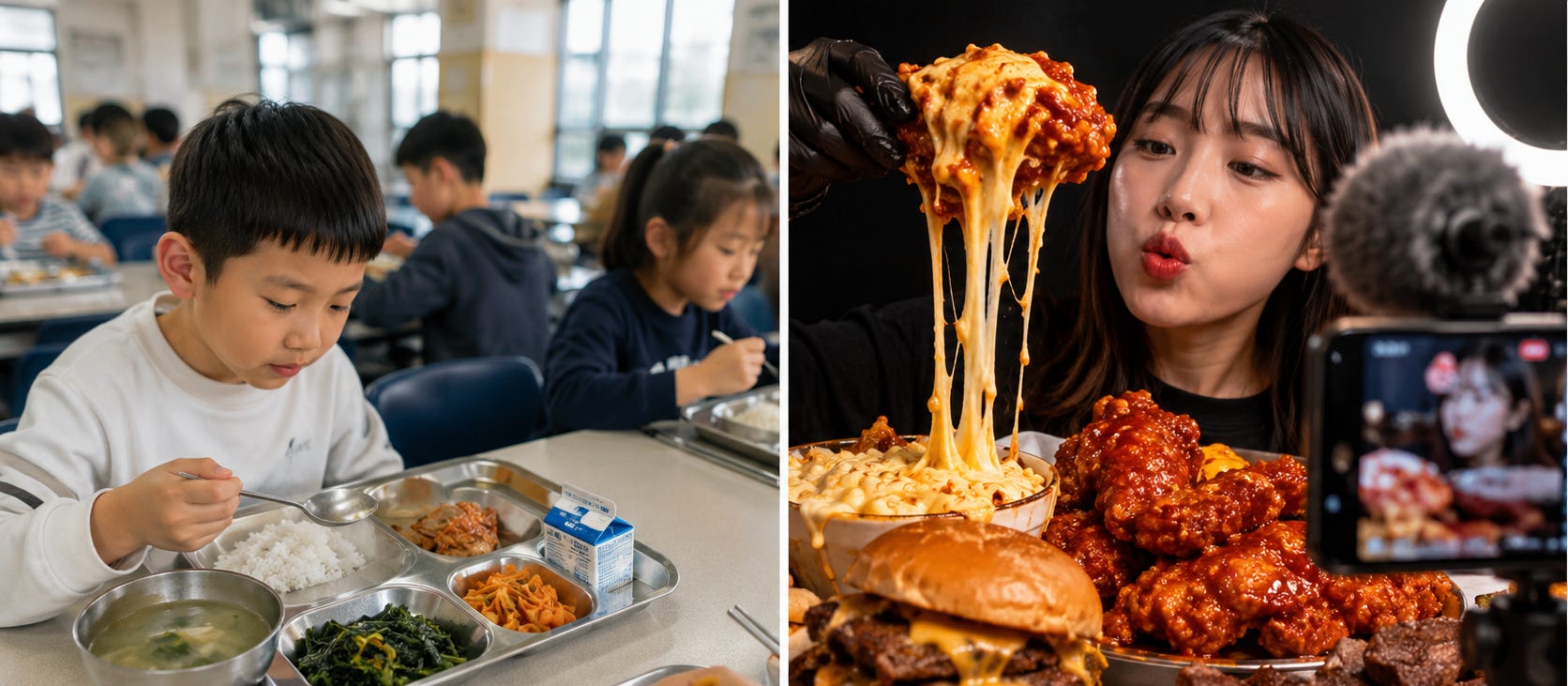
A school lunch is not supposed to compete with a YouTube thumbnail.
It cannot always bubble dramatically, stretch with cheese, crunch into a microphone, or arrive covered in the red glow of spicy sauce and algorithmic promise. It is food planned under budget limits, nutritional standards, labor constraints, and the impossible task of feeding many children quickly.
An elementary school nutrition teacher, writing in a Korean education magazine, described what this looks like from the cafeteria floor. Students, she wrote, increasingly compare ordinary school meals with the dramatic, meat-heavy, highly seasoned foods they encounter through media. They ask for “more meat, more meat,” while vegetables and traditional side dishes become harder to defend. In one especially vivid example, even a spoonful of spinach could become a small educational crisis.
This is the problem with asking a school lunch to compete with a mukbang thumbnail.
The lunch has nutrition standards, whereas the thumbnail has melted cheese, red sauce, dramatic lighting, and no obligation to teach anyone to like spinach.
This is where mukbang becomes part of a much bigger food environment.
The issue is not that one child watches one video and suddenly refuses spinach. The issue is that children live inside an ecosystem of taste cues: convenience foods, delivery apps, influencer meals, spicy challenges, ultra-processed snacks, school lunch, family schedules, body-image pressure, and the constant online comparison of what looks exciting.
In that ecosystem, ordinary food can start to look disappointing.
A vegetable is not boring by nature. It becomes boring when placed next to a digital flood of hyper-seasoned, hyper-edited, hyper-reacted food.
This is one reason media literacy and food literacy belong together. Children need to understand not only what they eat, but how food is shown to them, sold to them, and made desirable.
A close-up of sizzling cheese is not neutral.
A thumbnail is not a meal.
And a creator’s appetite is not a nutritional guideline.
How Two Governments Responded
No country has navigated mukbang’s social implications quite like Korea and China, and their institutional responses could not have been more different.
Korea: The Government That Blinked
In 2018, South Korea’s Ministry of Health and Welfare announced plans to develop mukbang guidelines as part of a national obesity prevention strategy. The proposal suggested monitoring content that “promotes excessive eating.”
The public response was immediate and fierce.
Cheongwadae gungmin cheongwon (청와대 국민청원), or Blue House public petitions, filled with protests. The argument, repeated across platforms, was essentially: what I watch in my own time is not the government’s business.
The policy did not advance in any meaningful way.
This outcome is worth pausing on. It is not simply a story about government overreach. It is evidence that mukbang had, by 2018, become part of Korean cultural citizenship, representing something people felt they had a right to, not merely a thing they happened to enjoy. When the government tried to touch it, they discovered that the screen-table had become almost as protected as the dining table.
China: The Government That Acted
China’s response was categorically different.
In 2021, China passed the Food Waste Prevention Law, which included provisions targeting mukbang-style content. Platforms were required to restrict or remove content depicting excessive eating, and creators faced potential fines.
The backdrop was striking in its irony: just a few years earlier, China’s Taobao had reported 1.6 billion cumulative viewers of mukbang-adjacent content in a single year, with food sales surging 400 percent in its wake. A country with one of the world’s largest and most enthusiastic mukbang audiences had decided, at the government level, that the genre was incompatible with national values around food waste and frugality.
The contrast between Korea and China reveals something important: mukbang is not culturally neutral. The meanings it carries, about freedom, restraint, appetite, community, display, and responsibility, are read very differently depending on who is watching and who is governing.
A comparative study of Korean and Chinese university students found that the two groups’ primary motivations for watching also differed meaningfully: Korean viewers tended to use mukbang as a substitute for offline social connection, while Chinese viewers were more likely to use it for active online socializing and information-gathering.
Two different hungers.
Two different uses for the same screen.
So What Is a Real Meal?
This is where I want to bring in another Korean book: Jung Jung-hee’s Not Mukbang, Not Proof Shots, But Meals (Meokbang malgo injeungshot malgo siksa, 먹방말고 인증샷 말고 식사, 2024).
The title alone is almost an argument.
Not mukbang.
Not the proof shot.
A meal.
The book asks what it means to eat well in an age when food is constantly photographed, broadcast, rated, recommended, delivered, compared, and consumed as content. It asks us to pay attention not only to whether food tastes good, but to where it came from, who prepared it, what it does to the body, what it does to the planet, and what kind of relationship it creates between people.
It poses a deceptively simple question: in an era where every meal is either performed for a camera or photographed for social media, what does it mean to simply eat?
Not to broadcast eating.
Not to document eating.
Not to eat in a way that generates content, approval, or engagement.
Just to eat.
The book explores what has been lost when the meal becomes media, when the act of eating is less about nourishment and relationship and more about how it looks and how many people are watching. It asks whether there is something that cannot be digitized, cannot be scaled, cannot be sponsored, and cannot be made into watch time: the quiet experience of actually being present at your own table.
I find this question genuinely difficult to answer. Because on one hand, I believe everything I have written in this series about mukbang’s social function. I believe that the screen-table offered real company to real people in real loneliness. I believe that the impulse to eat with others is so deep that humans will find any way to approximate it.
But I also believe that there is something to Jung’s concern. A meal that is performed, even one delivered with warmth, skill, and genuine connection, is still a performance. Somewhere in the distance between the screen and your own plate is the question: are you actually here? Are you actually eating this?
Are you actually with anyone?
A Mirror, Not a Verdict
Mukbang is proof that people improvise. When the shared table weakened, Koreans built a screen-table. When the screen-table became oversaturated and commercially compromised, viewers argued, translated, investigated, criticized, defended, and demanded better. When the government tried to restrict what they were watching, they pushed back and won.
The genre has produced extraordinary comfort and significant harm. It has given lonely people company and anxious teenagers unhealthy benchmarks. It has made some creators very wealthy and left most of them invisible. It has surfaced real questions about authenticity, labor, appetite, and what it means to eat in public.
None of this makes mukbang simply good or bad. It makes mukbang Korean, in the deepest sense: a response to a specific set of pressures, longings, and social conditions, improvised in real time, at a scale that surprised everyone, including the people doing it.
Mukbang was not born because Koreans forgot how to eat together.
It was born because they remembered too well.
And its complications — the economics, the betrayals, the regulations, and the backlash — are simply what happens when that memory becomes an industry.
Next week, we follow the food off the screen and ask: how does it get to the table in the first place? We turn to Korea’s delivery culture, baedal (배달), and what it reveals about urban life, convenience, and the quiet transformation of the Korean meal from something you prepare into something you summon.
The part about the asymmetry of the apology really struck a chord! It’s wild how influencers lose all that screen presence the second a scandal hits and just retreat to a quiet community tab.
At its core, mukbang relies on us believing the eater's actual reaction. When hidden ads and editing tricks ruin that, the whole magic collapses. It stops feeling like a shared meal and starts feeling like a corporate transaction. This was such a fantastic, spot-on analysis! Looking forward to the next one. 🙌