
64. The People Inside Convenience
Behind Korea’s fastest comforts is a labor market that keeps making workers visible as service, but invisible as people.

A small summer note before today’s essay:
This week’s piece was originally planned as a paid essay. I read and took notes from two books while preparing it, and the more I worked on it, the more I felt that this story should be shared more widely.
So I’m sending it to everyone.
It also feels like the right moment to tell you about a small change.
Understanding Korea has grown into a place where I can explore Korea in all its layers: food, care, labor, education, democracy, family, memory, and the invisible systems underneath everyday life.
And because I care about this work so much, I want to be honest with you.
Keeping up with the weekly rhythm has been meaningful, but it has also started to feel a little breathless. Each essay and companion podcast takes a lot of reading, thinking, writing, recording, editing, and emotional energy. And lately, I’ve realized that I need more room for the slower kind of thinking this project really needs.
So for July and August, I’m going to take a summer pause from the regular weekly rhythm.
I hope you’ll understand this not as stepping away from the work, but as a way of caring for it.
This project has become too important to me to rush. I want to keep doing it with depth, care, and joy, and I want it to last.
This is not a goodbye. It is a reset.
Paid subscribers will receive a three-month extension as a thank-you for your support. During this pause, I’ve also lowered the paid subscription price, so if there are essays in the paid archive you’ve wanted to read but couldn’t access before, this is a good time to explore them.
When I return, I hope to come back with a more sustainable rhythm, though I’m still thinking carefully about what that should look like. I know I want to keep writing this newsletter and making the companion podcast, but I also want to protect the deeper book work that is beginning to grow out of these essays.
So rather than promising a new schedule too quickly, I’m going to use this pause to think honestly about what kind of rhythm will allow this project to last, without losing the depth and care that brought many of you here in the first place.
Thank you for reading with such generosity. I want this newsletter to last, and I want the work behind it to have the depth it deserves.
🎧Companion Podcast
The companion podcast is available here: 🎧64.The People Inside Convenience
This Week’s Essay
Before I step away for the summer, I want to leave you with one more story about the kind of everyday comfort that is never quite as simple as it looks.
At some point, convenience stopped feeling like convenience.
It became the weather.
You do not marvel at electricity every time a light turns on. You do not applaud indoor plumbing after every shower, although perhaps we should all be a little more grateful before coffee. In the same way, many of us have stopped being amazed when food, groceries, medicine, paper towels, socks, toys, batteries, or a single urgently needed bottle of sesame oil arrives at the door.
In Korea, you can order dinner and watch a small dot move across a map. You can ask for food to be left at the door. You can order groceries before bed and find them waiting outside in the morning, carefully packed, insulated, chilled, separated, and protected. If you have lived in Korea, this can feel ordinary. If you are visiting for the first time, it can feel like the country has quietly outsourced magic.
But I should be careful here.
Overnight delivery is not uniquely Korean. Readers in many countries will recognize versions of this convenience too. I live in the United States, and I have also experienced the small modern miracle of ordering something at night and receiving it the next morning. Amazon has trained many of us to become very calm about unreasonable expectations.
One-day shipping? Of course.
Same-day delivery? Why not.
A school supply my child suddenly needs tomorrow morning?
A replacement lacrosse mouthguard after we discover, far too late, that last season’s had been chewed into something no responsible parent should send back onto a field?
Delivered just in time, saving our family from minor domestic panic.
Naturally, I am grateful.
So this is not a story about how Korea invented convenience.
It did not.
The more interesting Korean story is how this kind of speed became woven into everyday urban life with such density, expectation, and social silence.
In Korea, convenience is not just a service. It is an atmosphere. It surrounds eating, shopping, commuting, parenting, studying, working late, living alone, and living in apartments stacked into the sky.
And when a convenience becomes an atmosphere, it becomes harder to see the labor inside it.
This week, I want to step back from the little moving dot on the delivery app and widen the lens.
For the last two weeks, I stayed close to the delivery worker: the person moving through traffic, weather, deadlines, customer ratings, and accident risk to bring food to someone else’s table. Through Park Jeong-hoon’s books on Korea’s delivery platforms, I looked at a painfully concrete question: why does the person delivering our comfort so often have to absorb the danger of the system?
This week, I want to look at the labor market that keeps producing this kind of work: work that is necessary but poorly protected, visible but easily ignored, constantly used but rarely understood.
The question is no longer only: why is delivery work dangerous?
The deeper question is: what kind of labor market keeps producing workers who are necessary, visible, and yet somehow not fully recognized?
For that question, I am turning to Dr. Seung-yoon Lee’s 보이지 않는 노동자들: 경계 없는 노동, 흔들리는 삶, a Korean-language book whose title I would translate as Invisible Workers: Boundless Labor, Unstable Lives. Published in 2024, it deserves a much wider English-speaking readership.
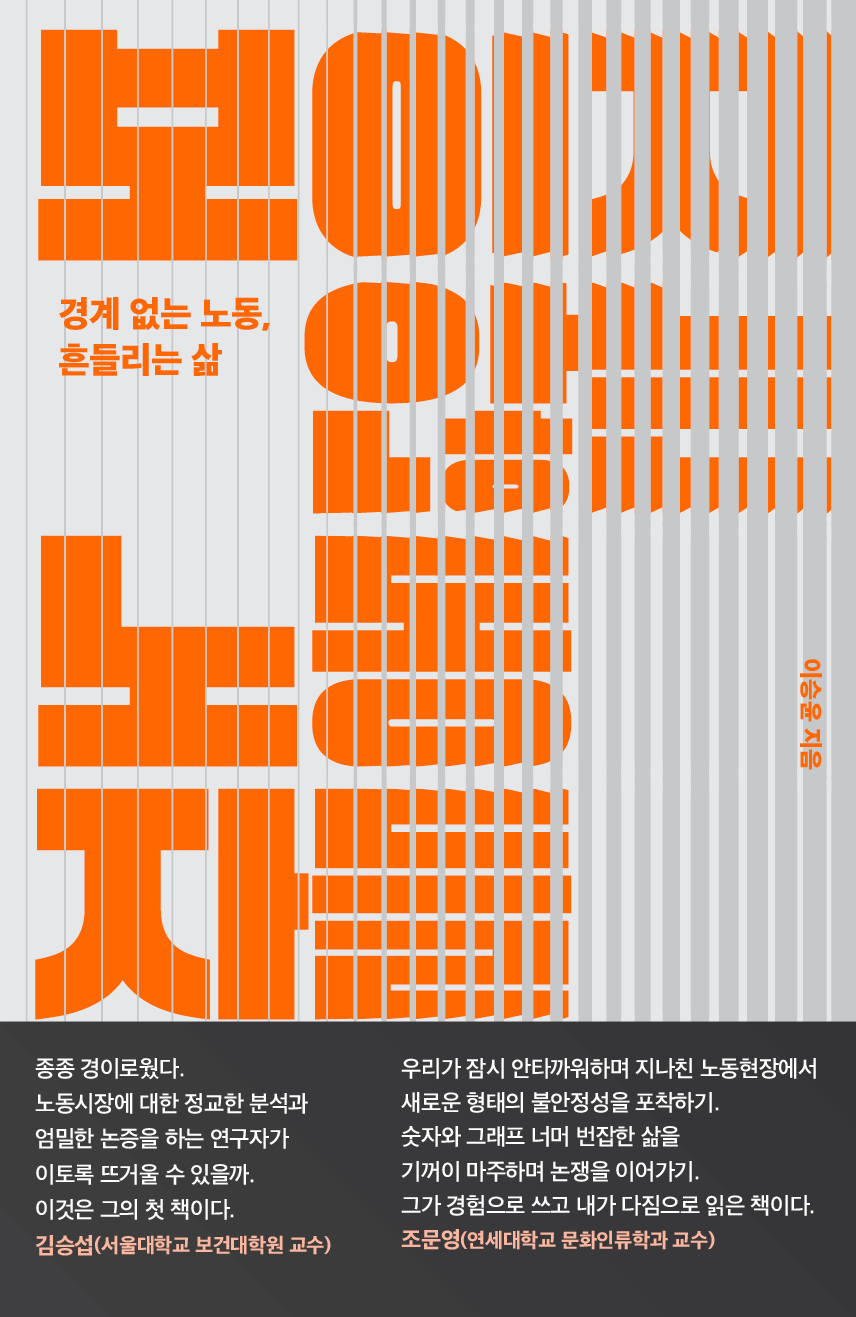
Dr. Lee is a professor of social welfare at Chung-Ang University whose work focuses on the welfare state, labor markets, precarious labor, income security, and social policy. This is not a sentimental book about “hardworking people,” although hardworking people fill its pages. It is not a simple exposé of bad companies, although bad systems and bad incentives appear often enough to keep one’s blood pressure politely elevated.
It is something more useful: a map.
Dr. Lee gives us a way to understand a labor market where old categories no longer hold. Regular worker or irregular worker. Employee or self-employed. Workplace or home. Working time or waiting time. Boss or algorithm. Injury or personal misfortune. Freedom or survival.
The lines blur. And when the lines blur, responsibility becomes fog.
That fog is where invisible workers live.
Korea did not invent the invisible worker. But Korea helps us see how easily invisible labor becomes ordinary life.
The Worker We See Every Day
Invisible workers are not necessarily people we never see.
Often, they are people we see so often that we stop seeing them as workers.
The courier at the door.
The cleaner in the office building.
The call center worker whose voice must stay calm while everyone else loses patience.
The school cafeteria worker who feeds children by the hundreds.
The subcontracted worker in a factory owned by a company whose logo we know, but whose labor structure we do not.
They are not invisible because we cannot see them.
They are invisible because we have learned not to recognize them.
We see the delivery. We do not see the delivery worker’s insurance status.
We see the app. We do not see the contract.
We see the box. We do not see the sorting center.
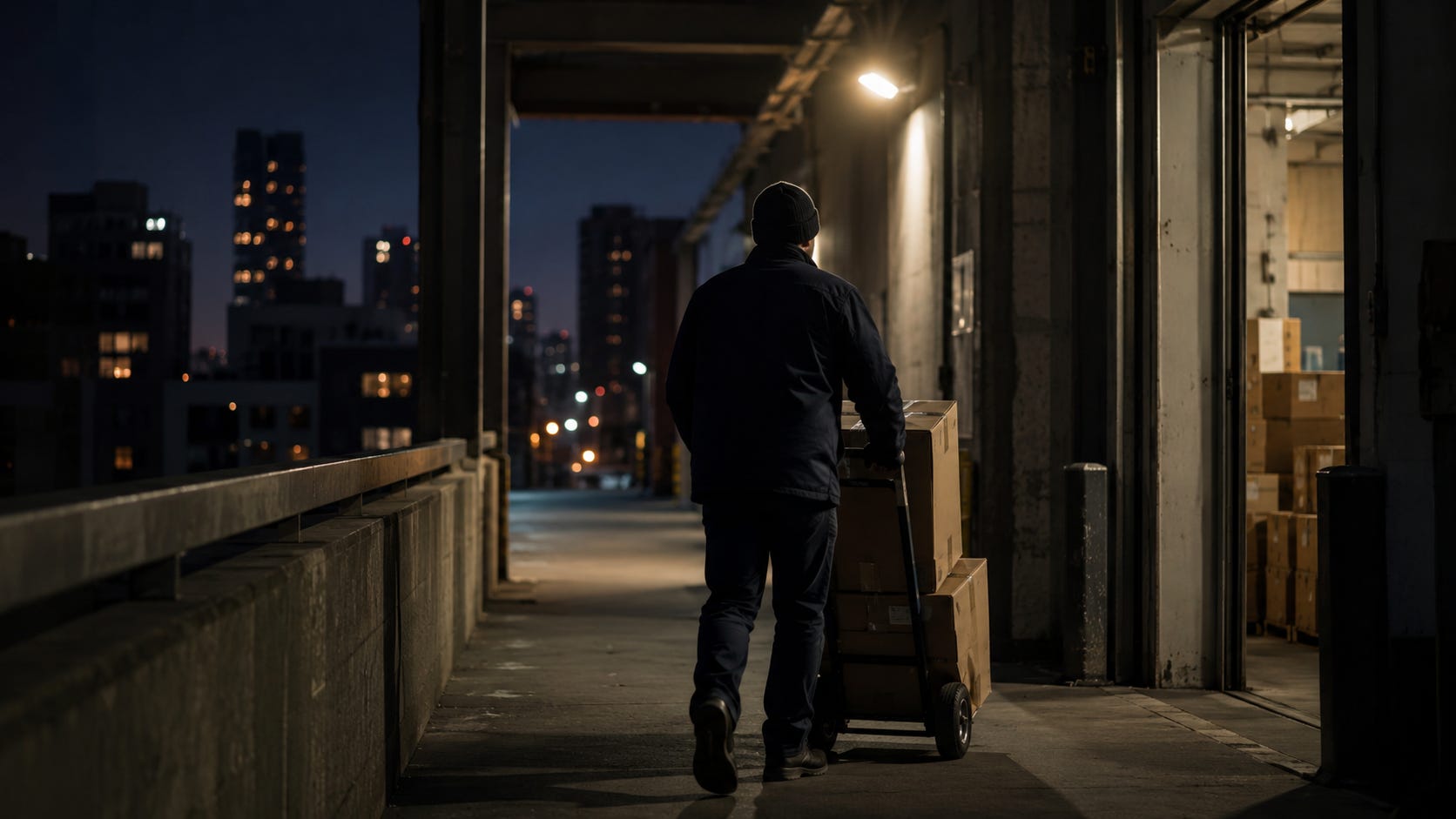
We see the fresh strawberries placed neatly at the door. We do not see the person who handled them at 3:47 a.m., perhaps while fighting sleep, hunger, cold, heat, or the silent terror of falling behind.
This is one reason Dr. Lee’s book is so helpful.
She does not treat precarious labor as one occupation or one demographic. It is not simply “young people,” “women,” “migrants,” “freelancers,” “gig workers,” or “the poor.” It is a condition produced by changing work arrangements and insufficient social protection.
A precarious worker is not just someone with low income. The insecurity is layered. Employment may be unstable. Income may be irregular. Working time may be unpredictable. Safety may be weak. Social insurance may be inaccessible. The right to speak collectively may be limited. The person may look independent on paper while being tightly controlled in practice.
In other words, precarity is not only a smaller paycheck.
It is a smaller life.
Or perhaps more precisely, it is a life squeezed into narrower and narrower margins by systems that keep calling the squeezing “flexibility.”
Flexibility is one of those words that sounds delightful until you ask who is bending.
When Labor Melts
One of Dr. Lee’s key concepts is “melting labor.”
It is a beautiful phrase for an ugly problem.
Modern labor law and welfare systems were built around a relatively solid image of work: a worker employed by a company, at a workplace, during working hours, under a recognizable employer, in exchange for wages.
That model never covered everyone fairly, of course. Women’s unpaid labor, informal labor, agricultural labor, domestic labor, migrant labor, and many other forms of work were always pushed to the margins. Still, the legal imagination of the modern welfare state often rested on a fairly stable picture of the worker.
But what happens when work melts?
The workplace becomes the street, the platform, the home, the car, the warehouse, the phone.
The boss becomes an app, a client, a subcontractor, a franchise system, a dispatch order, a customer rating.
Working time becomes difficult to measure because waiting, driving, sorting, logging in, preparing, repairing equipment, answering calls, and chasing the next job are all part of the work, even if not all of them are paid.
The worker may be legally called self-employed.
But if the price is set elsewhere, the schedule is shaped elsewhere, the customer is assigned elsewhere, the ranking is calculated elsewhere, and the penalty is imposed elsewhere, how independent is this independence?
Imagine being called your own boss, but your boss is an app, your access to work is rationed by an algorithm, and your income depends on rules you did not write.
This brings us back to a term we touched upon recently: sajangnim (사장님). When we first looked at this word, it felt like a quirky cultural paradox of the delivery world. But through the lens of Dr. Lee’s framework, this polite honorific transforms into a much darker systemic joke.
In Korean, the word means “boss” or “business owner.” On the surface, calling a courier sajangnim sounds like a sign of respect. It is the ultimate, cost-free corporate upgrade: you get the grand executive title, but absolute zero executive power.
But in the brutal math of melting labor, the costume comes with a heavy price. If you are officially the boss, then perhaps the vehicle is your problem. The fuel is your problem. The accident is your problem. The unpaid waiting time is your problem. The broken phone, the damaged package, the insurance gap, the sore back, the rain, the heat wave, the customer complaint: all yours.
A boss with no real power is not a boss. That person is a worker wearing the costume of a business owner, and the costume is not warm enough for a night delivery shift.
The Poverty of Time
Dr. Lee’s most useful insight may be this: poverty is not only about money. It is also about time.
Everyone receives the same twenty-four hours per day, which is one of those statements that is technically true and socially misleading. Time is not distributed equally because the power to control time is not distributed equally.
Some people buy time. They order food, hire help, pay for delivery, take a taxi, subscribe to services, use childcare, outsource errands, automate bills, pay fees, pay tips, pay premiums.
Others have to give up their time in order to survive. And what they give up is not only the official working day, but all the unpaid time around it: waiting, commuting, sorting, searching for the next job, recovering from the last one, and worrying about tomorrow.
The cruelest form is double poverty: income poverty and time poverty together. If a worker is paid enough, longer hours may at least reduce income poverty, though at a cost to health and family life. But if the pay is low, unstable, or piece-rate, more work does not necessarily lead to security. It may simply consume the remaining parts of life.
Sleep becomes negotiable.
Lunch becomes expensive.
Rest becomes suspicious.
A day off becomes not leisure, but repair.
The body becomes a machine that must keep borrowing from tomorrow.
Here Dr. Lee’s framework meets a remarkable scene from Hu Anyan’s I Deliver Parcels in Beijing, which I first read in Korean translation as 나는 북경의 택배기사입니다. Hu is a Chinese writer who worked nineteen jobs across cities, including hotel work, retail, gas station work, convenience store night shifts, warehouse work, and courier delivery.
Hu’s book is not a policy report. It is not a sociological map of an entire industry. Its power lies elsewhere. He writes from the inside of work: the exhaustion, the calculations, the humiliations, the small jokes, the loneliness, the unexpected pride, and the stubborn human desire for freedom.
At one point, Hu calculates his time as a courier in Beijing. He works out his daily pay, his hours, the time needed to sort parcels and travel to his delivery zone, and then arrives at a frighteningly precise conclusion: each minute has a cost.
Once time becomes money at that level, life changes shape.
A bathroom break is no longer only a bathroom break. It has a price.
Lunch is no longer only lunch. It is food cost plus waiting time plus lost delivery time.
A customer who does not answer the phone is not only inconvenient. The silence has a measurable cost.
This is the part that stayed with me: the violence is not only that the worker has too little money. It is that even ordinary human needs begin to appear as financial errors.
To be thirsty is inefficient.
To eat is indulgent.
Even going to the bathroom means losing time, and losing time means losing money.
There is something almost absurd about this, and yet not funny. Or perhaps it is funny in the way modern life is often funny: ridiculous until you realize someone is paying for the joke with their knees.
Hu’s Beijing courier and Korea’s overnight delivery worker do not live in the same country. They do not work under the same legal system. They are shaped by different histories, governments, labor regimes, and platform ecosystems.
But both reveal a world in which the consumer’s saved time must come from somewhere.
Convenience does not abolish time. It relocates it.
The Magic at the Door
One of the strongest scenes in Dr. Lee’s book begins not in a warehouse, but in a home.
While living in Berlin, Dr. Lee used grocery delivery. The service was useful, especially while managing work, childcare, and life without a car. But it came with limits. Delivery time slots were broad. Weekend and Sunday delivery were restricted. Packaging was minimal. Groceries arrived in a way that still reminded the customer that getting things to the door took time, labor, and coordination.
Then Dr. Lee returned to Korea.
On moving into a new apartment, she saw an advertisement promising that if she ordered before going to bed, groceries would be delivered to her door by early morning. She was skeptical enough to try it almost experimentally. If food ordered late at night really appeared outside the door by morning, it would feel like magic.
And then, in the morning, there it was.
Not just delivered. Perfectly delivered.
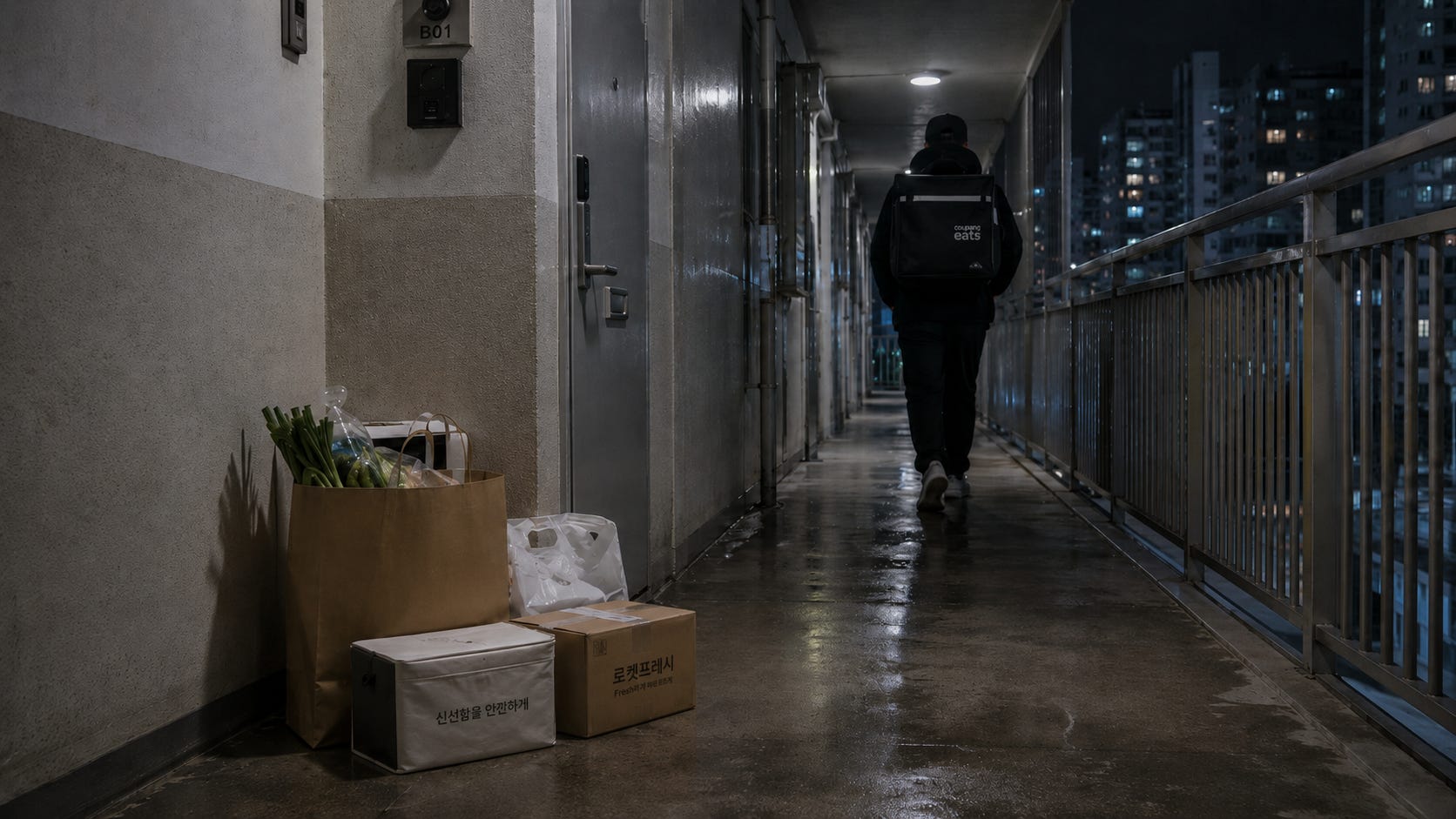
Frozen items were insulated. Refrigerated items were kept chilled. Everything packed to prevent damage, spoilage, inconvenience, and disappointment.
The groceries were protected beautifully.
And that is when the question came: were the workers who delivered them protected too?
That question sits at the center of this book.
Because the problem is not that fast delivery exists. The problem is that the object often seems better protected than the worker.
The egg must not crack.
The lettuce must not wilt.
The yogurt must remain cold.
The customer must not wait.
The app must not show delay.
The platform must not lose market share.
And the worker?
The worker is expected to absorb the instability that the system carefully removes from the consumer experience.
This is not just Korea. Readers in many countries will recognize versions of this system: same-day delivery, overnight delivery, grocery apps, meal platforms, quick commerce, packages that seem to arrive almost before desire has fully formed.
The difference is not that Korea alone has fast delivery.
The difference is that Korea makes the pattern unusually visible because of its density, speed, apartment living, digital adoption, consumer expectation, and already fragile labor categories.
Korean cities, especially Seoul and the surrounding metropolitan area, are built in ways that make rapid delivery logistically tempting.
High-rise apartments concentrate demand.
Dense neighborhoods shorten routes.
Customers are accustomed to speed.
Competitive platforms race to make yesterday’s luxury into today’s baseline.
A society can become convenient one improvement at a time.
Then one day, what once felt like an improvement becomes the baseline expectation.
Regressive Innovation
Dr. Lee uses the idea of “regressive innovation” to describe a disturbing contradiction.
On the surface, fast delivery is a story of innovation. There are algorithms, fulfillment centers, demand prediction systems, automatic ordering systems, real-time tracking, digital platforms, logistics optimization, and data-driven management. It has all the vocabulary of the future.
But from the worker’s perspective, the future may feel oddly old.
Long hours. Physical exhaustion. Night work. Weak protection. Injury risk. Low bargaining power. Surveillance. Competition. Punishment. Replaceability.
The tools are new. The vulnerability is ancient.
This is why “innovation” is not a moral category. Something can be technologically advanced and socially backward at the same time.
A platform can optimize a route while disorganizing a life. An algorithm can reduce delivery time while increasing bodily risk. A system can protect strawberries better than spines.
That last line sounds dramatic, but the structure invites it.
In Dr. Lee’s discussion of early-morning delivery workers, the language of automation often hides manual labor. Workers still sort. Workers still lift. Workers still rearrange items so that heavy things do not crush fragile things. Workers still manage the gap between the clean promise of the system and the messy reality of physical objects.
One worker in Dr. Lee’s interviews points out that “automation” does not solve the problem of eggs under heavy items in a moving vehicle. Someone still has to make the delivery make sense.
The machine is never just a machine.
It is a machine plus hands.
Usually tired hands.
Night Work Is Not Just Inconvenient
Night work is not simply work at an unusual hour. It reorganizes the body.
Dr. Lee notes that international health authorities have classified night shift work involving circadian disruption as a probable carcinogenic risk.
But even without that classification, anyone who has cared for a baby, flown across time zones, pulled all-nighters, or stayed up too late “just to finish one thing” knows that the body has opinions about night.
The body is not a productivity app.
It does not simply accept new settings.
It complains in hormones, appetite, blood pressure, mood, memory, digestion, coordination, and eventually disease.
What makes early-morning delivery especially troubling is that some workers are not simply rotating through occasional night shifts.
They may be locked into night-centered work for long periods. Some combine night delivery with daytime work because one income stream is not enough. At that point, the question is no longer whether the job is hard. The question is whether the social arrangement is consuming the worker’s future health in exchange for the consumer’s present convenience.
This is where discussions of regulation become difficult.
If we restrict night delivery, do workers lose income?
If we limit working hours, do already poor workers become poorer?
If we raise labor standards, do prices rise?
If prices rise, do consumers rebel?
If consumers rebel, do companies cut jobs?
If companies cut jobs, where do workers go?
These are real questions. They should not be dismissed with moral slogans.
But Dr. Lee’s book pushes us to ask a better question: why is a bad job so necessary to survival in the first place?
If a worker cannot refuse dangerous work because the alternative is no income, the “choice” is not quite choice.
If a worker must trade sleep for rent, health for groceries, and family time for debt payments, the problem is not that this individual lacks discipline.
The problem is that the labor market has turned exhaustion into a survival strategy.
The Accident After the Accident
When we talk about workplace accidents, we often imagine the event itself.
A fall. A crash. A collapse. A heart attack. A machine. A scooter. A warehouse. A phone call. A news headline.
But Dr. Lee’s book is especially powerful when it follows what happens after.
An industrial accident is not over when the ambulance leaves. It continues in paperwork, proof, applications, medical bills, lost income, grief, guilt, family strain, and institutional silence.
A worker may be injured once, but the family is injured repeatedly by the process of seeking recognition.
This matters because Korea’s social protection systems often depend on application and proof.
A person must know what to apply for, how to apply, where to apply, what documents to collect, how to endure waiting, and how to survive financially while the system decides whether their suffering qualifies.
That is a brutal demand to place on people at the very moment when their lives have already cracked open.
Dr. Lee writes about families who are left not only mourning, but also learning the bureaucracy of death and injury. The state may eventually recognize an accident. A company may eventually be pressured. A case may eventually become part of public debate.
But “eventually” is a long time for a family living inside grief.
This is one reason invisible labor stays invisible.
The public sees the tragedy as an incident. The family lives it as an era.
Korea as a Magnifying Glass
So what is specifically Korean here?
Not the existence of precarious labor. Not the existence of overnight delivery. Not the existence of platform workers. Not the existence of people who are called independent while being controlled by systems they did not design.
All of that is global.
Korea matters because it functions like a magnifying glass.
Several forces come together with unusual clarity.
First, Korea’s urban density makes speed logistically possible. Dense apartment complexes create concentrated demand, and concentrated demand is a delivery platform’s dream.
Second, Korea’s digital culture normalized app-based life quickly. Food, groceries, banking, messaging, school notices, hospital appointments, restaurant reservations, apartment management, and government services all moved into digital routines with remarkable speed.
Third, Korea’s ppalli-ppalli culture, often translated as “hurry-hurry,” gives speed a cultural familiarity. I do not like reducing Korea to this phrase, because it can become a lazy cliché. But it still matters. Speed has long been associated with survival, recovery, competition, efficiency, modernization, and pride.
Fourth, Korea’s labor market already had deep divisions: regular and irregular workers, large firms and subcontractors, insiders and outsiders, employees and the self-employed. Platform labor did not create all these cracks. It entered a landscape where cracks already existed and made them easier to exploit.
This is why the Korean case is not exotic. It is instructive.
If you want to understand the future of work, Korea is not “over there.” Korea is one possible preview.
A very fast one, naturally.
The Dignity in Hu’s Detour
This is where I want to return briefly to Hu Anyan.
I do not want to use his book merely as evidence that “China has hard workers too.” That would flatten the book and insult the writer.
Hu’s memoir is powerful not only because he suffered through difficult jobs, but because he thinks through them.
He watches himself become calculating, tired, irritated, proud, ashamed, lonely, observant. He sees how work changes his body and his temper. He notices the absurdities of logistics. He remembers coworkers not as symbols, but as people with habits, flaws, strategies, jokes, evasions, and small dignities.
Near the end of one courier experience, after customers wrote notes thanking him, Hu reflects that he had been, for some customers, the best courier they had ever met.
That sentence moved me.
Not because it turns the story into triumph. It does not. He is not suddenly rescued by customer appreciation. Compliments do not pay rent reliably, and gratitude is not a labor policy.
But the sentence matters because it restores personhood.
He was not only a replaceable courier in a system of parcels, addresses, penalties, and minutes. He was also someone who did a job well enough to be remembered.
That is the tension inside all these stories.
Workers are treated as replaceable, but they are not replaceable to themselves. Or to their families. Or to the customers who, however briefly, realize a person has been carrying the system to their door.
The Ethics of Convenience
I do not think the answer is to scold consumers.
That is both unfair and ineffective. Most of us live inside the systems we critique.
I order things. I use delivery. I have been grateful for the arrival of groceries when life was too full, too tired, too messy, too parental, too everything.
Convenience can be care. For elderly people, disabled people, exhausted parents, overworked students, sick people, people without cars, and people living alone, delivery can be more than luxury. It can be support.
So the question is not whether convenience is bad.
The question is whether convenience has become too cheap, too fast, and too silent.
A society should be able to distinguish between convenience that supports life and convenience that consumes someone else’s life.
That distinction is not easy. But refusing to see it is easier, and that is the danger.
The moving dot is a person.
The box at the door has a labor history.
The fresh food that arrives before sunrise has passed through hands, vehicles, sorting systems, contracts, risks, and tired bodies.
The meal that finds us may have found someone else at the end of a very long night.
And once we see that, we can ask better questions.
Who pays for saved time?
Who is called independent but denied real control?
Who is visible as a service but invisible as a worker?
Who gets protected: the package, the customer, the platform, or the person?
I do not have a neat ending this week. Labor rarely gives us neat endings.
That may be why we prefer the app. The app simplifies the world into a dot, a route, an estimate, a notification.
But books like Dr. Lee’s and Hu’s complicate the dot again.
They return the body to the map.
They return time to the package.
They return the worker to the door.
Korea’s convenience is real. So is the labor that makes it possible.
The question is whether a society can learn to see both at the same time.
When I Return in September
When I return on Thursday, September 3, I plan to begin with the women who feed Korea’s children.
Dr. Lee’s book opened another door for me.
I had already been thinking about writing about children and food in Korea. Her discussion of school cafeteria workers gave me a place to begin.
So in September, I’ll start with school lunch: the warm, colorful trays that have made Korean school meals quietly famous online, and the women whose labor makes them possible.
Because sometimes the best way to understand a country is to ask not only what its children eat, but who works so they can eat it.
And with that, I’m going to step away from the regular weekly rhythm for a little while.
Thank you for reading this series with such care. Thank you for following me from eating alone to mukbang, from delivery apps to invisible workers, from everyday convenience to the people who make that convenience possible.
These subjects are not always light, but your generous reading has made the work feel less lonely.
I hope you have a restful, nourishing summer, wherever you are.
I’ll be reading, thinking, spending time with my family, and preparing the next season of this project with more space and care.
I’ll see you again in September.
Until then, thank you for being here, one story at a time.
Thank you for this detailed and compelling article, written with such diligence and expertise. To me, it really looks like a glimpse into the future. Personally, I try to avoid delivery services whenever possible because I consciously want to support bookstores, other local shops, and restaurants. Yet, I realize that this trend is bound to take hold here and in smaller towns as well. The way workers and the work itself are becoming invisible—and the fact that the struggle not only for wages but also for time is intensifying while hard-won union gains are being eroded—paints a picture that borders on dystopia. And the question you pose at the end of your article is one I ask myself time and again:
"A society should be able to distinguish between convenience that supports life and convenience that consumes another person's life."
Technological progress over the last few decades has enabled a massive increase in productivity. Yet, our working lives are becoming increasingly compressed. People have less and less control over their own lives. Only a small segment of our society benefits from this progress and is able to shape their lives according to their own wishes. I fear that we are becoming increasingly powerless in the face of this issue.
Thank you for your valuable work, and I wish you a pleasant summer break.
Oh, one more thing. I am so pleased that you are resting for a few weeks. You deserve it. Good job taking care of you first!