
42. Distance Zero: Inside Korean Caregiving When a Child Gets Sick
In Korea, care begins with touch, not distance.
🎧 Listen to the companion podcast episode!
This episode is more than just a reading of the essay. It is a deep dive into the personal stories that were a bit too wild for the page. Are you curious about the time my mother raised live bees on our balcony in Thailand for bee venom therapy? Listen to the full story behind my “muscle memory” of care.
I came back from a beautiful family trip to Vietnam and Korea with the usual souvenirs: photos, jet lag, and the kind of full-hearted gratitude that makes you swear you will “rest more” in the new year.
Then, the very next night, my seven-year-old spiked a fever.
In that moment, a specific kind of caregiving software booted up in my brain. Not the calm, rational kind.
If you are parenting in the U.S. (or anywhere shaped by U.S.-style pediatric culture), you probably recognize a different kind of “software.”
You check the temperature. You pull up the pediatrician portal. You run through the mental checklist: hydration, meds, symptoms, breathing, energy level. You keep one eye on the rule that governs modern family life like a tiny, invisible traffic law: “fever-free for 24 hours” before returning to school or daycare.
(Korea has similar rules: “5 days from symptom onset plus 48 hours fever-free” for flu, for example. But the culture of enforcement is different. The rules are there on paper, but many parents, especially in households where both parents work full-time, struggle to follow them strictly.)
All of that is care.

But here’s the question that surprised me while I was rubbing my daughter’s feet at 2 a.m.
Have you ever stopped to notice the grammar of your care?
Is it built on giving the child space to recover?
Or is it built on closing every inch of that space?
The Part That Surprised Me
I have lived in the U.S. for 23 years. I did my graduate training here. I built my career here. I taught American students how culture shapes the body and everyday life.
And still, the minute my child got sick, my body did not respond like an American parent.
It responded like a Korean mom.
Not because I was trying to “do Korean parenting.”
Because a certain kind of care was already stored in me, like muscle memory.
This is the first essay in a short series about what happens when a child gets sick, and how “care” can look completely different depending on the culture that trained your instincts. Today, I want to start with the core grammar of Korean caregiving, the thing everything else grows from.
I call it: The Geography of Care: Distance Zero.
The Geography of Care: Distance Zero
Let me ask you a deceptively simple question.
When did you start sleeping alone?
And if you are a parent: When did your child start sleeping alone?
In many American families, sleep and separation go together, mostly because routine is sanity. But real life is messier. When a child is sick, plenty of parents “camp out” in the child’s room for a night or two, or make a temporary deal: a few nights in the parents’ bed, then back to normal. Still, if the illness isn’t severe, many families try to keep the usual setup and have the child sleep in their own bed, just with more check-ins and comfort.
In Korea, we have a different map.
Even though modern Korean parents often use cribs for safety in the earliest months, “graduation” from the crib can lead straight into the parents’ bed. A (now older, but still striking) 2002 study found that nearly 88% of Korean children between the ages of one and seven slept with their parents. The researchers explained it not as a failure of training, but as a reflection of values: family bonds and interpersonal interdependence matter more than early independence.
Is that exact percentage still true today? I honestly do not know. The study is more than two decades old. But when I look at Korean moms around me, it still does not feel rare. Not even close.
And I’m part of that story.
My daughter had a crib in our room as an infant. But since she was about six months old, she has shared our king-sized bed.
My American mom friends sometimes ask, very gently, “But what about your sleep quality?”
I’ll be honest. It’s not great.
I get kicked in the ribs. I wake up to a cold foot on my neck. At least once a week I open my eyes at 3 a.m. to find that she’s rotated 180 degrees in her sleep. Her feet are on my pillow, her toes somehow inches from my face.
But I keep choosing it for three reasons.
First, it is a mutual desire for all three of us. It is not just that my daughter wants to be near us; my husband and I also find comfort in having her close. There is a profound sense of peace in falling asleep to the rhythmic, steady sound of her breathing. It makes our small family feel whole and safe, knowing we are all gathered together in one shared space.
Second, I know the window for these cuddles is closing fast. I am acutely aware that she will not want to sleep between us forever, and I want to soak up every moment of this physical closeness while I still can.
And third, I want her to wake from a nightmare and realize, instantly, that she is not alone. I want her first conscious thought in a moment of fear to be the immediate, tangible presence of her parents.
When she got sick, “distance zero” wasn’t a special choice. It was the default setting.
And in case you’re worried that bed-sharing automatically equals long-term harm, the newer research I’ve seen suggests it is not that simple. Associations between bed-sharing and later outcomes vary a lot depending on context, and some studies have found no clear long-term link to children’s internalizing or externalizing behavior problems.
But here’s the deeper point.
In Korean caregiving, closeness is not a vibe. It’s a form of responsibility.
Touch as Language: The “Healing Hand”
In the U.S., care is often a linguistic exercise. We practice “emotional coaching.”
We ask, “Where does it hurt?” or “Can you label your feelings?”
We teach children to own and manage their pain through words, following the psychological gospel of “Name It to Tame It,” popularized by psychiatrist Dr. Dan Siegel. The American Academy of Pediatrics encourages developmentally appropriate communication with children about their health, and in practice, this often means asking children to describe their symptoms and label their feelings.
This is not just about gathering information for a diagnosis. It is about building “emotional literacy.” By giving a name to their pain or fear, children are taught to move from the overwhelmed emotional centers of the brain to the rational, self-regulating prefrontal cortex. In this culture, teaching a child to master their pain through words is seen as the ultimate form of empowerment.
In Korea, we speak through our hands.
There’s a phrase every Korean child knows: 엄마 손은 약손 (Eomma-son-eun-yak-son, “Mom’s hand is a healing hand”).

It’s not just a cute nursery rhyme. It’s a tactile technology. When my daughter’s tummy aches, I rub her belly in rhythmic circles. I massage her feet using a specific foot reflexology book I keep on my nightstand.
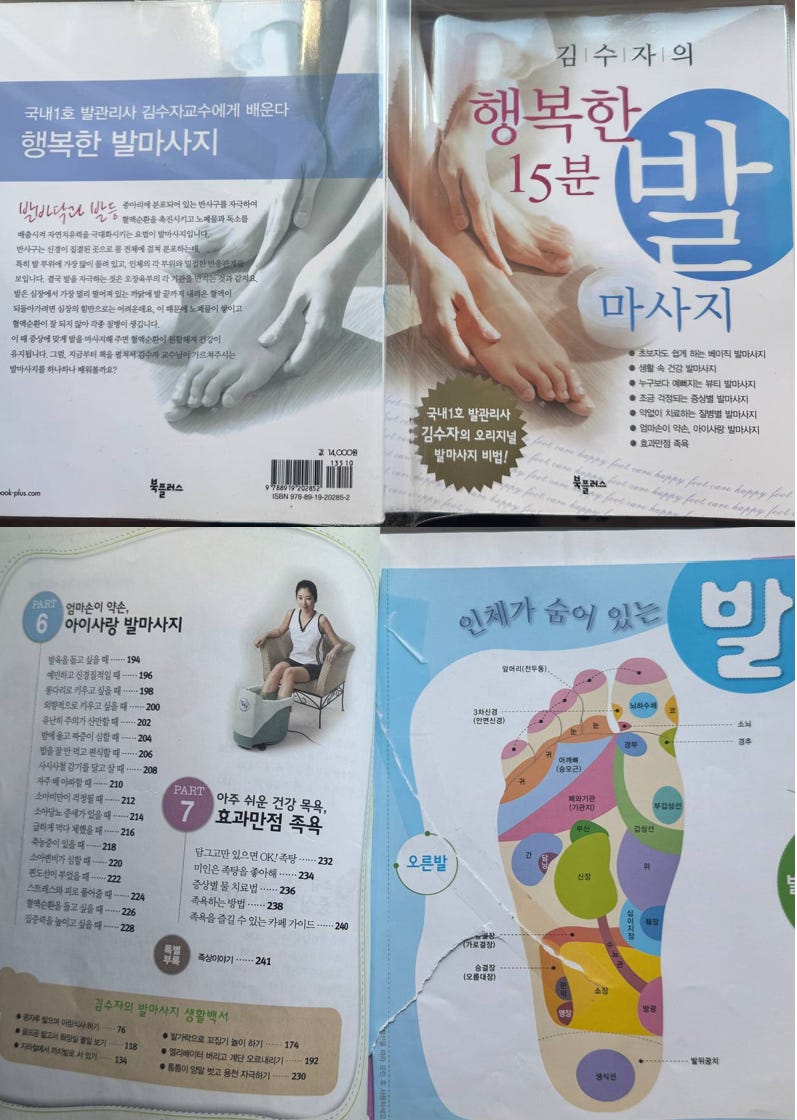
This isn’t just about the placebo effect. Physical touch releases oxytocin and lowers cortisol. In our culture, the goal of care isn’t just “recovery” in a biological sense. It’s “aching without loneliness.”
And in my experience, this really works.
When my daughter says her head hurts or her stomach aches, I press specific points on her hands or feet according to hand and foot reflexology principles. And she genuinely feels better. So much so that now, when she’s not feeling well, she asks for her hands and feet to be massaged first.
(My husband and I often tag-team during these long nights. We might start with me focusing on her hands while he massages her feet, but we frequently swap positions halfway through, alternating roles as we navigate the reflexology maps together.)
Su-Ji-Chim: The Korean Art of Hand Acupuncture
When I was young, my mother studied su-ji-chim (수지침, Korean hand acupuncture) at a traditional Korean medicine clinic. Su-ji-chim is a uniquely Korean system developed in the 1970s by acupuncturist Yu Tae-woo, based on the idea that the hand is a microcosm of the entire body. Each point on the hand corresponds to a specific organ or body part.
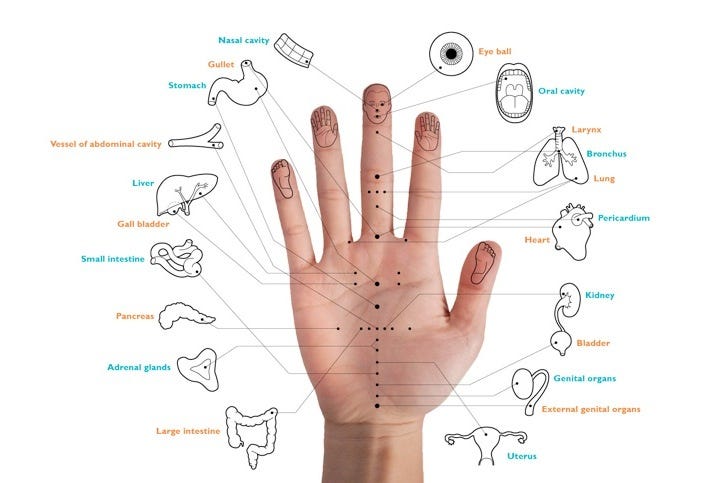
Whenever any of us in the family felt sick, she would insert tiny needles at specific points, and our pain would genuinely improve.
There’s another tradition many Koreans will recognize: finger-pricking for indigestion (son-ttagi, 손따기), where a parent or grandparent pricks a fingertip when a child says they are “stuck” or “blocked” after eating. My grandmother or mother did it to me whenever I needed it.
I do not do this with my daughter. She has never needed it, and to be honest, I’m too scared to actually prick her with a needle.
But based on my own experience, I genuinely believe this goes beyond just the comfort of being close to your child when they’re sick.
I’m not giving medical advice here. I’m just sharing what I’ve experienced: these practices worked for me, and the hand and foot massage techniques I use with my daughter work for her. Western medicine may not have a framework for it yet, but I consider this a form of treatment in its own right.
Living Between Two Worlds
Neither approach is inherently better or worse. They simply reflect different cultural assumptions about what a human being needs when they’re at their most vulnerable.
The American model values recovery plus the maintenance of age-appropriate independence.
The Korean model values recovery plus the reinforcement of the safety net.
Raising a daughter in America, I find myself living in both worlds at once.
I ask her, “Where does it hurt? Can you describe how it feels?” I teach her to name her pain the American way.
But my hands are already moving. Forehead first, then belly, then feet. I press the points my mother taught me, murmuring softly in Korean. I fall asleep mid-circle, hand still on her ankle, because my body won’t let me stop touching her when she’s sick.
My mind lives in the U.S., but my body still reacts in Korean.
Coming Up Next Week...
There is a beautiful side to this “proximity” culture, but there is also a hidden pressure. Behind this intense caregiving is a question I have been struggling with: Why do Korean parents feel like they have no choice but to do all of this? Why can’t we just “wait and see”?
Next week, I’ll be reviewing a book that helped me see this through a more sociological lens: Oh Chan-ho’s The Sociology of Marriage and Childcare (결혼과 육아의 사회학). We’ll look at the social structures that turn parenting into a high-stakes performance.
See you then.
I cried a little bit reading this. I feel like as a mom of a 3 year old, it has been difficult to navigate being a part of these two cultures. I felt so guilty sleep training my baby but felt the need to because I could not survive mentally or physically. And then after she was sleep trained, I started to co-sleep with her and on many nights, I still do. My husband values her independence and his sleep so he sleeps in our bed while I often sleep in my daughter’s bed with her. I can see my own Korean (born and raised) mother (I was born in Seoul and moved to the US when I was three) come in with so much anxiety and high performance when my daughter is sick. I can’t help but think that the cultural difference is what makes me observe her care with exasperation sometimes. I so look forward to your next post!